Trails of Enchantment
Renaissance Faire, Taylor-Mesilla Historic Site, Horno Thanksgiving, Chiricahua Desert Museum
Season 2025 Episode 4 | 27mVideo has Closed Captions
On this episode of Trails of Enchantment we take a stroll back in time to the 54th annual ...
On this episode of Trails of Enchantment we take a stroll back in time to the 54th annual Renaissance Arts Faire, then we take a visit to the new Taylor-Mesilla historic site, then visit Fort Selden for their annual horno thanksgiving and the final stop we visit the Chiricahua Desert Museum in Rodeo, New Mexico.
Problems playing video? | Closed Captioning Feedback
Problems playing video? | Closed Captioning Feedback
Trails of Enchantment is a local public television program presented by KRWG Public Media
Trails of Enchantment
Renaissance Faire, Taylor-Mesilla Historic Site, Horno Thanksgiving, Chiricahua Desert Museum
Season 2025 Episode 4 | 27mVideo has Closed Captions
On this episode of Trails of Enchantment we take a stroll back in time to the 54th annual Renaissance Arts Faire, then we take a visit to the new Taylor-Mesilla historic site, then visit Fort Selden for their annual horno thanksgiving and the final stop we visit the Chiricahua Desert Museum in Rodeo, New Mexico.
Problems playing video? | Closed Captioning Feedback
How to Watch Trails of Enchantment
Trails of Enchantment is available to stream on pbs.org and the free PBS App, available on iPhone, Apple TV, Android TV, Android smartphones, Amazon Fire TV, Amazon Fire Tablet, Roku, Samsung Smart TV, and Vizio.
Providing Support for PBS.org
Learn Moreabout PBS online sponsorshipWelcome to Trails of Enchantment where we travel and discover the diverse culture and nature of the borderland region.
Where we share the stories of the places, the art and the people that make up this beautiful land.
We are here to preserve and celebrate the uniqueness of the past.
Share a taste of the present community.
and engulf the bright future that awaits.
Trails of Enchantment.
Let's start on the trail.
Grab your cloak and sword.
Our first stop on this quest is to the Doña Ana Arts Council's 54th Renaissance Arts Faire.
People voyage here every year for their love of costumes, death defying entertainment, music and of course, turkey legs.
Today is the 54th Las Cruces Renaissance Arts Faire.
It's been going on in this town for over five decades.
We've got food, we've got art, we've got jousting.
We've got music and entertainment.
There's a lot of folks you'd be surprised.
A lot of our big entertainment is actually from the region.
So folks from El Paso, Las Cruces, they live here, they come here, they perform here.
So yeah, it's it's rather a homegrown event.
So I decided I was going to come dressed as a pirate.
This is kind of a last minute costume that I threw together for Halloween earlier but I was like, you know what?
Pirate Renaissance is close enough.
I think it's just super cool seeing how many people actually, like, really dressed up and put a lot of effort into their outfits.
You know, like, I come from a bigger city, so coming to Las Cruces, I was like, oh, it's a smaller city.
Probably the events are smalle size, but this is crazy.
There's so many people that like really have like a lov for this culture and everything.
So seeing everyone dressed up and really put so much effort into what they do here is really awesome.
I'll try a couple tricks under the leg.
Under the other leg.
Under the biggest leg.
The running kick up.
Nice.
Woo!
So I started unicycling when I was ten years old.
My grandma bought one at garage sale for the grandkids.
And my brother and I showed up one day and we saw it.
And so every time we visited we would practice.
And we both eventually lear and could ride around the block.
And 36 years later, I'm still doing it.
I started out on street performing, and that's a really good way to learn how to perform, because you learn instantly what works and doesn't work.
So, you know, the first couple months, very tough because I wa I don't know how to entertain.
I knew the tricks, but I couldn't I wasn't connecting with people.
I wasn't building an audience, and I wasn't making much because of that.
And so I just kept trying every day over and over and over again.
And you just get better.
You learn what to say, what not to say.
And then pretty soon you crowd starts to build and you just get better.
Yeah.
No, I love it.
Like it's just one of the best jobs in the world because I'm making people of all ages, all religions, all whatever.
And like, everyone's having fun together, you know, and I'm looking out and I'm seeing grandpas laugh and little kids and teenagers and, you know, all sorts of people.
And it's just.
Yeah, it's so rewarding.
Like, it fills me up knowing that I created that and I made them happy.
And then they make me happy by cheering and clapping and, yeah, it' and it's some wonderful things.
It was fun.
I'm surprised he wasnt gonna let me do the knife I was excited, but then he took it back.
And then I did the little kid one, sadly.
And then he jumped over me.
I thought he was going to kill me for a second.
It was scary.
My eyes really jumped out.
This is the Renaissance Faire that happens every year in Las Cruces.
And where you are right now is at the booth of the Astronomical Society of Las Cruces.
We come here every year.
We set up our telescopes, and whatever's in the sky, we show the public, whether it's just the sun and all the sunspots and solar flares that are coming off of it.
Or occasionally there's actually planets like Venus or Mercur that we can see in the daytime, and we'll show those to the public as well.
This year we have an extended booth where we're doing, work with, with the kids and doing, basically STEM kind of stuff with them.
They're building bracelets that change color in the sun.
and, we're just having a great time.
A lot of fun out here.
That's what th Doña Ana Arts Council has done they have so many varieties of things that they've got going on.
And it's it's a wonderful experience.
But we couldn't possibly do this without people who are willing to come out and be a part of this organization and, and help.
And I'm so glad that we have our volunteers.
Ohh ahhh.
{people cheering} {people cheering} Finish it already.
Yeah.
straight-away.
{people cheering} The next stop on the trail is to Fort Selden Historic Site.
Here we'll roll up our sleeves with interpretive ranger Michael Bailey, who's going to teach us how to bake bread in a traditional horno oven and give some interpretation on what Thanksgiving was like for the soldiers here long ago.
Morning, everybody.
Good Morning.
And in a horno you're going to treat it just like an oven you would at your home, right?
So we want to get around that 450 range.
We got it pretty hot this morning.
We've been here since six at six this morning.
getting it going.
You'll see the the heat crack in the front.
I haven't had one there before.
So it got a little hot.
I'm thinking we got abou a thousand degrees this morning.
So when you get this thing really blaring hot, it'll cook a frozen pizza in about 90 seconds.
But, you could run down to the dollar store and get a Red Baron and you wouldn't kno that it's a frozen pizza, but.
But if you think about it, you know, this is the OG.
You know, pizza.
It's a wood fire oven, basically.
But they're very versatile.
This year, what we did was we use the horno to bake some sourdough bread, which, which was interesting, but I think it was overall a success.
I didn't realize that it was going to be as challenging.
And, you know, some of the people gave, you know, tilted their hat for me cooking sourdough because I guess it's a little a little, you know, it's a little interesting.
It can be hard sometimes, but overall I think it came out pretty well.
but, you know basically, you know, connecting, the local heritage, yo know, the horno, with the site, given that they used hornos here at Fort Selden Historic Site, the soldiers did.
You know, hornos being a, you know, a staple, you know, in New Mexico, not just southern New Mexico, but all over New Mexico.
Hopefully this turns out good, guys.
Like I said, it' my first time doing sourdough.
And here we done bread rolls and things like that in the past.
but yeah, it should.
Sourdough is my favorite bread.
Traditionally they would have just put it on the floor.
What we call, you know, boy, boy scout peppering isnt going to hurt anybody, but there's hot spots in this oven.
And you said you left the fire in the wood in there.
I had to I had to build it up again because it's easy to start hot and and cook and then let it come down.
But then to get the temperature back up, because there's a lot of mass here.
Right?
So its 6000, almost 6,000 pounds It's a lot of dirt, to get it hot.
Like to get it heated up.
That's why we were at six here at 6 a.m.
this morning.
it takes several hours to, to get it to temperature.
So the horno, they date back thousands of years.
One thing I find really interesting is that how cultures, different cultures around the world and independently developed, basically the same style of cooking.
So, you know, to the best of our knowledge, hornos date back to the Ottoman Empire, like back to northern Africa you know, some 5000 years ago.
But like I said, they they were used, around the world and different, different cultures independently.
So one, one culture.
didn't you know it didn't influence another.
But yeah, it's just a way, way of cooking.
Now, what we regard as an horno you know, it's Spanish for oven.
These really are due to th Spanish influence in New Mexico.
So this technology, if you will, even though it just looks like a, you know, a hunk of mud.
it really is a technology, that was brought, you know when the Spanish came through.
And that also connects us to us, to our site because we have, you know, El Camino Real de Tierra Adrento that comes right through our site, with Don Juan Oñate in 1598.
So it's just like kind of a, you know, a blending of our different layers that we have here you know, at Fort Selden Historic site.
What I really am interested in, because they, they had a wonderful green chile and cheddar, sourdough loaf, which, I gave to my fiance, and she, she was like why would they put green chile?
I'm like, why wouldn't you Like, you put it in everything.
Oh, yeah.
All right.
I'm not going to cry.
It came out okay.
The aluminum is not even that hot.
If anybody wants to run down to the dollar store and get a pizza, I'll throw it in there.
{Laughing} I'm, like, afraid to cut into it.
Lets see.
It's like, still a little.
Yeah, it's a little gooey.
The outside is good.
But on this one we're going to sacrifice one to see this one's okay.
Oh yeah.
That one came out good.
I think the other ones are good.
But come dig in.
All right.
I'm proud of myself.
As an interpreter.
One thing I took, like, very personally and it really made my day was the lady said, well, you sparked my curiosity.
I'm.
I'm going to dive down this sourdough, you know, rabbit hole.
she she was talking about how she's going to go home and and start a starter and, and do that.
So I think at the end of the day, if we can, you know, inspire just one person to, to go home and do something, you know, what we did here today?
I think that it was a success.
Next, a chance to walk off that holiday meal at the brand new Taylor- Mesilla Historic site.
Thanks to the Taylor family in partnership with the State of New Mexico, this site has become an art museum, Mesilla story hub and a southern New Mexico time capsule.
These buildings actually have been here for quite a while.
So, we're talking, you know, 1850s mercantiles multiple families perla alidib.
Many, many, influential people actually operated or lived in these structures.
But when we get to the story of the state opening a historic site, it starts with J. Paul Taylor, Mary Daniels Taylor, and their children.
I think it was around 51 or 52.
They moved into the house here.
and they would rent out the storefronts.
it's kind of like a continuous home.
It's easy to get lost in.
And then in around 2004, J. Paul Taylor married Mary Daniels Taylor.
They signed a donation agreement to the state of New Mexico, with the stipulation that it would become state property after both of their passing.
And then, of course, after, J. Paul Taylor's passing, we stepped i to start doing some renovations, some historic preservation and then some safety upgrades.
One of the amazing things about this project, this historic site, is that we are an art museum inside of a historic home, on a historic site, on a historic plaza.
So the history just kind of keeps compiling.
and that makes it really unique.
So when visitors come in, they're going to come in through the Reynolds store, they're going to purchase their ticket, whether that's for a guided tour or self-guided experience.
and then they're going to be let into the museum itself.
The home.
The home is the museum.
and so as they continue through, say, they're on a self-guided experience, they're going to see artwork, I think the earliest pieces from the 17th century.
And that's in the small zaguán (covered patio).
so you're going to se everything from historic pieces to contemporary pieces to hacky sack in the dining room.
Because that's the other par of this incredible experience, is that this is a lived in home.
So, we have reinstalled all of the pieces exactly like they were, or as close to as we could.
It would have looked like with the family living here.
Throughout the site, we have four main interactives.
The first one being in the Reynolds store is that story vault.
We jokingly refer to it as the Mesilla-pedia, and it's a great opportunity for our visitors to come in, community member and answer questions or prompts.
So one of the, my favorite prompts is what is Mesilla mean to you?
And so, we invite the community and our visitors to answer those questions.
We then do some editing on the back end, and then we upload them to our listening stations, which are also in the Reynolds store, which is the visitor center.
And they'r people can put on the headphones and they can listen to community members and other oral histories, talk about, you know, everything from what Mesilla means to them to agriculture and so much more.
And then if you were to go into the house, into the museum itself, you're going to find two more interactives.
One of them is a map kiosk.
and it has historic maps.
and you can interact with them.
Click on hotspots and lear more about the local history.
And then the other interactiv that you'll find inside it's in the sala grand (large living room).
is going to be the architecture kiosk and it's going to highlight key, architectural features that yo would find in the borderlands, the southwest and here in Mesilla.
The grand opening was amazing.
So, we cut the ribbon, just after, 10 a.m.
So around 10:25, I spoke one of the children of J. Paul Taylor and Mary Daniels.
Taylor spoke.
That was Mary Helen Ratje.
and then we also had cabinet Secretary, Deborah Garcia y Griego.
She also got up and spoke, and then we cut the ribbon.
It was myself and Robert Taylor, who is the oldest son of the Taylor family.
we cut that ribbon, and then afterwards, we held a giant fiesta.
So we had music, performers.
activities, vendors, community partners.
it was family friendly to the nines.
This brings beautiful memories.
They did a great job of reconstructing.
Just putting everything bac together the way I remember it.
Thank you, J. Paul Taylor.
Yeah.
I think there was a lot of emotion.
you know this this is their family home.
and it is now a public space and that that comes with its own challenges you know, you know, not having, full access every day or something like that.
but overall, the family seems to be very pleased with what we've accomplished, and I know, you know, I've spoken to, almost every one of us.
I've spoken to every child, children and the grandchildren and nieces and nephews and cousins.
and they all, especially at the opening, seem to have a very happy and positive interaction with the site.
and I'm just so glad that we we get to be stewards of their, their family's story, but als Mesilla and of the borderlands.
So while we do talk about the family, of course, especially because of their generous donation, they have given us this amazing opportunity to build these connections for the community.
For our final stop on the trail, we head to the Chiricahua Desert Museum in Rodeo, New Mexico.
This museum is home to everything reptile live rattlesnakes reptile artwork and memorabilia, and even some rare Apache artifacts.
You know, I started out with exotics, and I was a I was a dealer, and I used to import.
And I used to supply about 300 pet stores back in the 80s with live pets, way back when reptiles were just becoming popular and kind of moved into publishing, and I've been a publisher now for the last 30 years.
I publish books and and herpetology and herptoculture, which is the husbandry of reptiles as pets.
But a lot of stuff with natural history lately.
I was into, turtles and toads and snakes when I was a little kid and, I've never grown out of it.
If you look right down there, then we have abou four gila monsters in this pen, and they live here year round.
So this is a collection of artwork, and a collection of artifacts.
Skeletons, skulls, shells live animals.
We breed a lot of really rare rattlesnakes and other snakes here that other zoos get from us.
And this is just a collection of everything herpetology, that you can see or want to see.
I did a book on the, surgica treatment of snake bites and, the book is here and this is a collection of old snakebite kit and snake oil bottles I've been collectin over the many years.
And, none of them do any good.
They don't.
They don't help you with any of the snake oils.
Don't fix anything.
The snake bite could still hel you with your snake bite.
So and the crazy thing is, they still sell thes in camping stores today.
The snake bite kits and they don't do anything.
So if you buy a snake go to the hospital.
Don't buy a snake bite kit.
A lot of people wonder abou this particular collection.
So, since I was a kid I collected, reptile beer bottle and anything when I. Of course I travel all around the world.
I've been most places.
But wherever I go, I always ask friends and people, hey do you have any there any beers that have reptiles on them?
And over the years I've made a lot of contacts and a lot of time what I find when I get 2 or 3 and other peopl collect them as well, and then I'm always trading the back and forth, these people.
So there's there's about or 4 of us that have this, these collections, and we're always tryin to help each other get items that we don't have.
So these are a collection of different beer and wines and, and sodas from around the world that have reptiles and they're advertising.
So this is my beautiful wife Sherry.
We brought her here on her honeymoon, and she runs our hat business, and she's built it from the ground up.
And we have over 180 different hat designs, but we sel to most of the national parks, United States, a lot of the state parks.
And, it's amazing how many hats we sell.
Literally, 500,000 hats, probably a year.
Best seller is Roadrunner.
Yeah, sure.
Yeah.
Go figure.
Yeah, yeah.
Dragonfly is really popular, you know, so.
But we got so many different birds, so many different reptiles that we do.
Yeah.
We've been really happy with how much, support we'v gotten from the parks and such.
They're always looking for quality stuff that does a little interpretation.
Talks about the wildlife of their area, and we've been able to do that and come up with some crazy new stuff.
We're doing a new mosquito hat, if you can believe it, but.
Oh, it's great.
When I come in here, my blood pressure drops, probably like 20 points, just because it's so relaxing and so calm.
Well, I've been collecting books since I was little kid.
Oh, anything new that came out?
Herpetology.
reptiles, amphibians, I would, I would buy and it kind of evolved from there.
And I bought everything around the world.
And of course, I became a publisher because and a book distributor so I could afford to bu all these books.
So when I was growing u and these books would come out with sometimes, 50 or $60, and as a kid you're like, I can't afford to buy every book.
So I started buying them wholesale and reselling them, and I keep one copy for myself and make money on other ones.
So and that's allowed me to be able to buy some of the books that we have at.
We have the largest, probably one of the largest collections of books in herpetology.
We have books that go back to the 1500s.
A lot of these books were cut u and they were made.
This is artwor to hang on walls.
So a lot of these book that didn't exist then, there were so few of them then, are even fewe because most of them got cut up.
But you can kind of see some of the artwork.
There's a Python just to show yo some of the difference.
Different thing that were drawn back there.
We use it for a science meeting.
So we have poster session in there.
And we're working on getting it all cataloged to where people can go online on the library herpetology website, and they can ask for information.
They're looking for a particular book.
They give us the author and the title of the book and tell us what they're looking for.
We'll make a digital scan of that part of it, and we'll send it to them for free.
I run conferences on the side, so I run, I run the NARBC conferences, in Chicago and in Dallas and so we've been doing that for 25 years.
So those shows are huge.
They're capture breed only shows people come from all over the world to see them, and they bring in masses of people.
And that also helps fund what we're doing out here.
Well there's a lot of costs of doing, you know, using hotels an facilities, convention centers.
So, in some of the science meetings that I've done in the past and helped to organize, I thought I'd built my own site, my own facility to do science meetings.
So that's what we built that for.
And, because I've also been collectin a lot of Apache artifacts here for the local over the last 16 years.
I basically filled it.
So we do 1 or 2 meetings a year over there, but the other time of the year, it's just a big Apache museum so people can see Geronimo's pre-surrender bone arrows anything you can imagine.
we, we did a timeline that goes through 25,000 years of human history as well, that you can walk through and kind of learn about the are and you have some kind of idea what happened out here.
I wa always a collector or a hoarder a my wife may call me.
So buying all these different things, and I always thought about doing a museum, and I had friends that had different, like reptile exhibits and things like that.
I wanted to take it to a different level, not just be a roadsid attraction.
So I was buying the stuf for 20 years.
And, you know we we finally said, hey, let's build a buildin and make it happen.
So it's a it's a tea of about 12 people that make everything happen out here.
We set up a nonprofit so we don't have any kids.
So our plan is to have all o this funnel into the nonprofit and hopefully being run by a university or something like that.
We're setting up to do continuing education with a wet labs and stuff out here and that so people, students can come from other colleges out here and do like a a summer cours or something like that out here.
So we're kind of looking at that to making it where it's, it pays for itself.
And another entit larger than us can take it over.
When I'm not here anymore.
All locally produced programming is available online at krwg dot org and Youtube dot com Thanks for joining us on Trails of Enchantment Will see you next time on the trail.
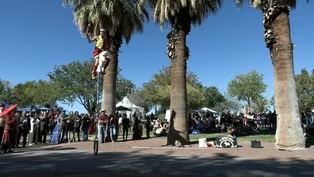
54th Annual Renaissance Arts Faire
Clip: S2025 Ep4 | 6m | Grab your cloak and sword because our first stop upon this quest is to The Doña Ana Arts Council’s.. (6m)
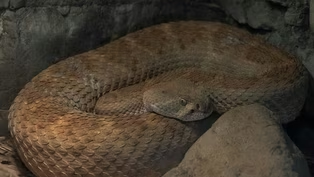
Clip: S2025 Ep4 | 7m 39s | We head to the Chiricahua Desert Museum, in Rodeo New Mexico. This museum is home to... (7m 39s)
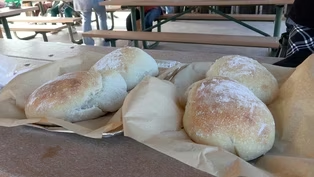
Clip: S2025 Ep4 | 5m 53s | Next stop on the trail is to Fort Selden. Here we will roll up sleeves with Interpretive Ranger... (5m 53s)
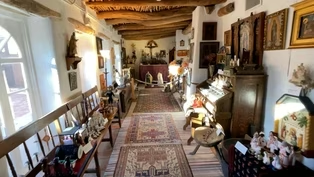
Clip: S2025 Ep4 | 6m 21s | Lets walk of that Thanksgiving bread at the brand-new Taylor-Mesilla Historic Site. (6m 21s)
Providing Support for PBS.org
Learn Moreabout PBS online sponsorship












Support for PBS provided by:
Trails of Enchantment is a local public television program presented by KRWG Public Media