Prairie Yard & Garden
The Plant Addict
Season 39 Episode 5 | 28m 45sVideo has Closed Captions
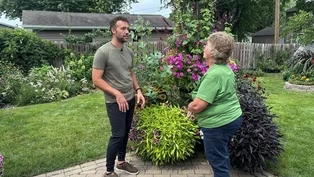
Charles Elhard is a devoted plant enthusiast, meticulously tending his vast, vibrant collections.
Charles Elhard is a true plant devotee. Fitting the definition of an enthusiast, he pours himself into meticulous yard work and stunning plantings. Whether he's tending his vast houseplant collection or curate vibrant floral containers, his life reflects a deep, focused passion for all things green.
Problems playing video? | Closed Captioning Feedback
Problems playing video? | Closed Captioning Feedback
Prairie Yard & Garden is a local public television program presented by Pioneer PBS
Production sponsorship is provided by Shalom Hill Farm, Heartland Motor Company, North Dakota State University, Friends of Prairie Yard & Garden, and viewers like you.
Support provided by:


Prairie Yard & Garden
The Plant Addict
Season 39 Episode 5 | 28m 45sVideo has Closed Captions
Charles Elhard is a true plant devotee. Fitting the definition of an enthusiast, he pours himself into meticulous yard work and stunning plantings. Whether he's tending his vast houseplant collection or curate vibrant floral containers, his life reflects a deep, focused passion for all things green.
Problems playing video? | Closed Captioning Feedback
How to Watch Prairie Yard & Garden
Prairie Yard & Garden is available to stream on pbs.org and the free PBS App, available on iPhone, Apple TV, Android TV, Android smartphones, Amazon Fire TV, Amazon Fire Tablet, Roku, Samsung Smart TV, and Vizio.

Visit the Prairie Yard & Garden Website
Do you love gardening? Consider becoming a friend of Prairie Yard & Garden to support this show and receive gifts with your contribution. Visit the link below to do so or visit pioneer.org/donate.Providing Support for PBS.org
Learn Moreabout PBS online sponsorship(gentle light music) - Some of us have family members that love to shop, some love to go to the grocery store, some clothing stores, and even shoe stores.
Plus, now stores can be at our fingertips, which opens up a whole new world of shopping online and throughout the world.
Today, we are going to meet a young man who loves to shop for collect and grow plants.
I'm Mary Holm, host of "Prairie Yard and Garden," and let's go visit my friend Charles, whose Instagram account says it all, fargoplantaddict.
- [Presenter] Funding for "Prairie Yard and Garden" is provided by Heartland Motor Company, providing service to Minnesota and the Dakotas for over 30 years in the heart of truck country.
Heartland Motor Company, we have your best interest at heart.
(bright music) North Dakota State University through its field to fork educational program, providing research-based information on growing, preparing, and preserving fruits and vegetables.
Mark and Margaret Yackel-Juleen in honor of Shalom Hill Farm, a non-profit rural education retreat center in a beautiful prairie setting near Windom, Minnesota.
And by Friends of Prairie Yard and Garden, a community of supporters like you who engage in the long-term growth of the series.
To become a Friend of Prairie Yard and Garden, visit pioneer.org/pyg.
(bright music fades) (bright upbeat music) - I've known Charles Elhard for probably 20 years.
It is so fun to connect at regional horticulture events and it's nice to visit about plants because he loves them and is so knowledgeable.
I also knew he was great at putting together hanging baskets and combination planters for friends.
Then, I saw a video that he posted of his yard with all the plants he grows, and I knew we had to have him do a show with us.
So I called and he said, yes.
Thanks Charles for letting us come.
- Welcome to my yard.
- Tell me what's your background.
- Oh, well, I grew up on a dairy farm in Jud, North Dakota, just about 40 miles south of Jamestown for those who don't know where that's at.
I've been digging in the dirt since I was little, little.
There's pictures of me when I'm three years old sitting in the garden driving my truck.
High school, I had the opportunity to work at my Aunt Nancy's greenhouse.
So I got a lot of experience working with flowers and annuals, perennials.
A lot of credit to her.
And my grandmothers were both big gardeners.
My mom was a big gardener.
And then I decided to go to NDSU for horticulture, built my career from there.
I'm now with the North Dakota Department of Agriculture working in the plant protection area.
- So how did your plant addiction get started?
- Oh, I think just working with my aunt at the greenhouse, working with my mom in the garden.
I have a great little story.
From second grade, we had to do a career box or write about what we wanted to be when we grew up, and mine actually says horticulturist.
So it goes way back.
I wanted to be a gardener, so my teacher looked up horticulturist and we made the box out of that.
I actually kept the letter that shows what I want to be when I grow up.
- [Mary] So when did you move to this location?
- [Charles] I've been in this house since 2012.
There was nothing here except deep rock all the way around the house.
So it's been several years in the making, but I think it's turned out okay.
- [Mary] Where did you start?
- [Charles] I started in the front yard.
I wanted a nice kind of formal front entrance.
Started there and then just slowly worked my way around the yard.
I started with probably pretty basic barberries and daylilies and hostas.
At that point, I was just more familiar with those plants.
And from there, I started experimenting with all different things and I have a giant fleeceflower on the corner, which is fun.
A smoke bush that's probably a little outta control, but I've always liked the look of a smoke bush.
Crept around the west side of my house and I wanted to probably keep with the formal flow.
So I started with irises and some more daylilies and then planted some echinacea, and those decided to self seed.
So I turned that into my wildflower garden.
- [Mary] Why did you use the particular plants that you did on the front and on the side?
- [Charles] Kind of recommendations.
When I used to work up at a nursery here north of Fargo, Neil Holland was the owner, very knowledgeable man.
I learned a lot from him.
He kind of made some recommendations to start out.
I planted some of the things he suggested and then it's changed a little bit.
Some plants died.
I like to say that when a plant dies, you shouldn't feel bad about it because it gives you an opportunity to put in something new.
So always trying something else.
- Now do you collect or do plants that remind you of other places or of your travels?
- I do like the prickly pear cactus.
I love going to Arizona and going hiking and seeing all the cactus everywhere.
There aren't a lot of cactus we can grow here.
So I put in some of those and they're doing great.
I have fireweed, which can be fairly invasive, but I'm trying to keep it under control.
But when I was in Alaska, the mountains are covered in fireweed, absolutely drawn to that.
So I didn't bring seed back from Alaska, but I did collect some seed in northern Minnesota.
- So do you have some garden fails too?
- Oh yes, always fails.
Usually it has to do with planting things too close together in the garden, in the flower beds, in the containers, for sure.
I always put more plants in the container than survive, but then at least, you know, which ones are doing the best, so.
- Charles, what are some of your more unusual plants that you're growing?
- Okay, well, where do I start?
I have a ginkgo tree in my front yard that I'm very proud of.
You don't see a lot of them, especially up here in the north.
It's done really well.
I had a researcher tell me, it's probably one of the nicest ones in Fargo.
So I feel really good about that.
Gas plant, you don't see that very often.
It's a great, very aromatic, oily plant, bright pink flowers.
That is a perennial.
Kind of hard to find.
But supposedly if you catch it at the right time, you can light a match by it and it'll make a puff of smoke 'cause of all the oils.
I haven't been successful, but that's what people say.
I have a yellow horn, which is a large shrub or can become a tree, but very rarely found in the trade.
I heard about it at the NDSU arboretum and so I had to have one.
The nuts are supposed to taste like macadamia nuts.
I haven't gotten any yet, but we'll see how that turns out.
Another tree that I really like is a snakebark maple.
Unfortunately, the rabbits chewed it to the ground last winter.
It's coming back really nice, but you can't see the nice snakey bark that it has white and green variated bark.
I have a tomato plant called woolly Kate that one of my greenhouse friends gave to me to try.
The leaves are super fuzzy and supposedly the tomatoes are super fuzzy too, and then there'll be a bright yellow or yellow-purple striped tomato when they grow.
So I'm looking forward to see how that grows.
- [Mary] With all of your plants, do you have trouble with critters?
- [Charles] Oh, I have trouble with rabbits.
There seems to be a giant population in the city of Fargo.
So throughout the winter, if I didn't get a fence around plants, they definitely got chewed on.
I have an apple tree in the back, my northpole apple.
One of the first trees I planted in the yard when I moved in.
It had never bloomed and never bloomed.
And then over the winter, the rabbits decided to chew two feet of bark off the bottom all the way around.
I tried to bridge graft it, but was unsuccessful, so it's probably going to die.
And wouldn't you guess?
This spring, it bloomed like crazy and it's covered in apples.
We'll see if they make it to ripen, but I'm not.
I don't have much hope.
- [Mary] Well, you have such beautiful annuals and perennials, but can I see your containers too?
- [Charles] Sure, yeah.
Let's take a look at those.
(bright country music) - Peppers are one of the most versatile things in your garden.
They can be sweet or so hot that they make your eyes water.
The heat in peppers is measured in Scoville heat units, and it has a wide range of spiciness when you're cooking in your kitchen.
So the lowest level is the bell pepper.
Bell peppers have a Scoville heat unit value of zero, whereas if we go to a jalapeno pepper that has a Scoville heat value of 2,500 to 5,000.
And then we can get really spicy, and we have ghost peppers and also Carolina reaper peppers and those are way over a million.
So anytime that you are cooking with peppers, especially the hot ones, be sure to wear plastic gloves.
Otherwise, you could damage your skin.
And if you happen to rub your eyes, you could hurt your eyes.
So be very cautious when you're working with peppers in your kitchen.
Try some different types of peppers in your cooking.
If you're canning, remember that you have to keep the total amount of peppers the same because you're a scientist when you're canning.
You can adjust the heat by choosing a different type of pepper.
I'm Dr.
Julie, bringing the field to your fork.
Until next time.
(bright country music) - Charles, your planters are gorgeous.
Are there certain plants that you really like to use in your containers?
- Yes, there are, petunias.
I really like to try all the different new cultivars.
It seems every year there's different varieties, so I don't think maybe there's only one repeat from a previous year in my planters this year.
Some are not good, but I like to try 'em anyway.
I like to use like the salvia.
I think I use this type of salvia.
Every year I get a lot of hummingbirds.
So that was really fun to have and they really like the salvias.
Coleus, this raspberry tart coleus is a really unique one.
Again, it's a new variety that I had to try, so I gave that a shot.
Sweet potato vineis a classic container plant.
So I like to put that in just to take up space.
And I stick with the thriller spiller and filler effect.
Try to get all categories there.
Sometimes I overfill my planters, but some years I will do very symmetrical planters where you have two of the same on either side.
This year I decided to do something a little different and did I think this pot has five different plants, just trying to get that background.
The thriller goes in the back and then spills forward.
- [Mary] Please tell me how you made this.
- So this is one of those projects that took umpteen trips to the hardware store, but I have a full whiskey barrel on the bottom here, and then there's a half whiskey barrel, just a plastic one on top of it.
And then I took a two-inch PVC pipe and ran it all the way through and had to get all the right fittings to put this basket and hold it all together.
Spray painted the PVC pipe to make it look like it's metal.
And so far it's held up in the wind and the rain and all the storms we've had.
I have the two planters here and then two large, I believe they're 24-inch planters here to frame the whole thing.
I also have... So all of my containers are on drip irrigation.
So I have not had to hand water other than a couple pots all summer long.
So I think that helps a lot with the consistent moisture.
I do like to fill my pots all the way with soil.
I used to put styrofoam or plastic bottles in the bottom, but they seem to dry out by the end of the summer or dry out faster by the end of the summer.
So I fill them all the way full with soil and then replace about a fourth of it every year.
- When you get your plants, do you start them yourself from seed or do you buy, or how do you do that?
- It's a combination of everything.
I have a few, like these salvias that I pointed out.
I did grow those from seed.
There's a few.
Most of the containers are plants that I've purchased from local garden centers.
I do start a lot of my own vegetables.
I have a few annual scattered here and there that I do start from seed as well.
- [Mary] Where do you do that?
- [Charles] I have a seed starting room in my basement.
I have some shelving racks set up, and they're all lighted and I start lots and lots of seeds every year.
- [Mary] Well, I think I saw a greenhouse too.
- [Charles] Yes, I have a greenhouse.
Plants go in there about April 1st-ish.
So a couple months in the house.
And then once our temperatures are right around maybe 25 is my minimum that I like to keep track of for the heat.
Then they go out there.
- So do you save some of the plants from one season to the next?
- I try, I try.
With mixed success, sometimes like my succulents, I will take cuttings of them and root those and keep those over winter so I can use them again.
I will save seeds from some annuals or perennials throughout the garden.
And there's a few plants like my dahlias, I will dig out the roots and attempt to over winter them.
I have some gladiolas that I usually will over winter.
Those are super easy to keep in the house.
And then there's a few plants that I will try to over winter as a house plant.
- [Mary] Well, I think behind you, I think I see a tree with some fruit on it.
Is that an apple tree?
- [Charles] It's called espalier.
It's a French style of pruning.
It's very lateral.
My goal with that tree was to get several different varieties grafted on it and keep it short, easy to harvest when it does fruit.
I've had limited success with my grafting.
I think I need to take some lessons, but I did.
this year I successfully got two varieties on.
The tree itself is a wedge apple, older variety.
And then I got one variety that has red fleshed apples on it, and I have, believe it or not, a pear grafted onto it.
- [Mary] Wow.
Then, do you have quite a bit of fruit here in your yard?
- I do.
In my small yard, I have nine different types of fruit.
Mostly tree fruit, but I have honey berries.
I'm playing with blueberries even though they hate the pH of our soil.
I have some pear trees, some cherry trees.
I love my cherry trees.
Last year, I harvested 50 pounds from these two small trees.
They're the sour cherries that came out of the University of Saskatchewan.
I'm trying some blackberries in the back with limited success because they usually die to the ground every winter.
- Well, you mentioned succulents.
Can we see one of your succulent planters too?
- Sure, let's take a look.
Mary here is my succulent planter, or one of my succulent planters that I've created.
This frame used to be a different type of planter.
It wasn't very successful, but I had this bushel basket that there were mums in one fall, and it started to fall apart.
So I thought, well, what can I do with that?
But it fit perfectly into this frame.
And I just pulled out the panels that were falling apart and stuck succulents in them.
So I have kind of a two level succulent planter.
It's done really well and I don't have to water it hardly at all.
I take cuttings of this over winter those, and then I can bring them right back out.
The frame came with a kit that I had ordered, the bottom pot was one I had on hand.
And then there's some bolts and a frame that you put it all together with the succulents in this planter too.
I like to choose different colors and different textures.
So you can see the reds, the blues, the purples, some greens.
And each one is a little different.
We have the rosette type, kind of the spiky look, the wild mange look on top.
- [Mary] Do you do this for friends or for other people?
- I do, but it's a secret.
- Okay.
- I have a few friends that'll drop their planters off every spring or they'll ask for suggestions.
And I also have a couple greenhouse friends that ask for help in the spring.
So I'll go out and help them with their custom combos or help them with the planters that they put out for sale.
Just a creative outlet for me.
- [Mary] So how many do you end up making each year?
- [Charles] Oh boy, I bet I'm approaching five, 600 every year.
- [Mary] Oh my gosh.
You are a master at it then too though.
But do you have other kinds of planters that you've created?
- [Charles] Oh, there's one that I did this year.
I had a friend who had an old pallet, a big pallet that they didn't know what to do with but they didn't want to throw it away.
So they said, here, "You can do something with this."
So I turned it into an herb garden.
It's standing upright.
I lined it with landscape fabric and just started planting and it's turned out pretty good.
- [Mary] So do you use quite a few herbs in your gardening and your cooking?
- I don't eat a lot of green things.
I just like to grow things, so.
- Well, can we see even the things, some of the perennials along your wall?
- [Charles] Sure, let's go take a look.
(gentle bright music) - I have a question.
I love to grow small tender plants, but the wildlife just love them.
What could I do to protect these plants from these little creatures?
- Well, one of the things to do I always like to tell people a good fence is your best defense.
So even though fences are not the most desirable feature in a landscape, it does protect those newly planted plants, and particularly some that are really delicious for rabbits and small animals from being completely demolished before they ever reach any kind of productivity or maturity.
Here we have an example of a comparison of what we've been doing where we have fenced our cabbage.
This is called CaraFlex cabbage, and then we've also not fenced some of it.
And clearly inside the fence, the plants are doing great, no animal damage whatsoever.
They're getting to be nice and full, versus over here, behind the fence, we've got some big bites out of leaves.
We clearly have had some browsing from the rabbits.
So here we're showing this example between these two.
So while a fence is not the best looking thing, and you can certainly be creative with your fencing, it's really important particularly when those plants are small and most vulnerable at their early size.
- Here is my fence covering flower bed.
I like to landscape all the way around the yard it's easier to mow and maintain, but I have the opportunity to put in a lot more plants that way.
And then I also like to introduce different colors so you have things blooming throughout the whole season.
This one, which is not blooming yet, is called monkshood.
Not a lot of people have it.
This is another plant that was in all the botanical gardens in Alaska.
It's also a very poisonous plant.
So pets or kids should stay away from it.
But this one will bloom probably the week or two weeks before it freezes up.
So sometimes I don't get great color, but it's dark blue and very pretty.
- [Mary] And then I see you've got some black-eyed Susan Vine.
Is that something you plant every year?
- [Charles] It is.
I collect the seed every year too.
So I start that myself.
You can also see another plant on that vine, and I have some hardy kiwi that I've been trying to start on that trellis.
So the black-eyed Susan Vine is kind of a filler until that grows up, but the kiwi vine is taken right off.
Here, you can see the blueberries that I mentioned don't like our soil.
They're very struggling.
I did have blueberries last year.
They were delicious.
Nothing this year, thanks to the rabbits.
- [Mary] (laughs) Now, allium.
I always think of that as a spring bloomer.
- [Charles] Yes, there's... I've found some varieties that'll bloom all season.
There's some fall blooming varieties.
This one's called millennium.
It's a very nice landscape plant, very reliable.
I really like to throw in some alliums.
I have some other ones here that bloom this spring, but they still look unique once they've dried up.
So I leave those alone.
Another plant that I really like, it's not blooming now, but the itoh peonies, they're the hybrids between the Japanese tree peonies and your standard garden peony.
Kind of expensive, but definitely a novelty item that's mandatory for every garden.
They don't get the powdery mildew.
The flowers don't flop over.
So I have about four or five different ones in my yard.
- [Mary] And you have flocks now blooming.
- [Charles] The flocks looks great.
You asked about natives.
I have spiderwort and then some milkweed in the back.
Haven't seen any monarch caterpillars yet, but hopefully yet this year.
- Now you have a love for plants and you're known as the plant addict.
Do you have plants inside too?
- I do.
I have to do something in the winter.
- So how many inside plants do you have?
- At last count, I have 158.
- Where do you keep 'em all?
- There's a few all over the house, but I also have a bedroom dedicated all to house plants.
So most of them are in there.
- [Mary] And how do you get them enough light?
- [Charles] I've supplemented a lot of light.
Since 2020, people have been very interested in house plants.
There's a lot more lighting that you can purchase.
There's a lot more types of pots, a lot more plant varieties.
Even some of the rare varieties that were very expensive and hard to come by are now available for very reasonable prices.
So there's some pretty neat ones in there.
- [Mary] Well, did you build shelves in order to hold all those plants?
- [Charles] I did.
I started with just buying little shelving units that were decorative, and then I had too many plants, so I had to build... I think I have six levels on my one wall.
- [Mary] Oh my gosh.
Now I know for work and for pleasure that you do a lot of traveling, but who takes care of all these plants when you're gone?
- [Charles] Oh, the houseplant I've learned are the more you have in a room, the more they rely on each other.
So the humidity is a little higher in that room and they tend to last a long time.
I think I only water about once a month in there, and then I have all my containers on irrigation.
And if I need family or friends to stop by, I've got people in town that can help out.
- [Mary] Charles, do you wash or dust your plants inside at all?
- [Charles] Sure, about once a year I'll haul them all outside and give them a good rinse.
That's about it.
I usually forget.
- Well, then when you get a new plant to feed your addiction, do you keep them separate for a while?
- I should.
I ended up with a big mealybug problem in some of my Hoyas, So they've been isolated to the greenhouse.
But from now on, I learned my lesson.
I know we're told to isolate 'em in a different area, but I will have to do that.
- Do you take cuttings and gift some of your plants to friends?
- I do.
I have one from my friend Whitney.
We've exchanged cuttings back and forth, and I actually have quite a few cuttings going right now.
When I was trying to clean up the mealy bug problem, I took a bunch of cuttings, or if my plants just get too long, you know, how pothos like to grow and grow and grow.
So I like to chop 'em up and start a whole bunch more.
- [Mary] Can you monitor your irrigation?
- [Charles] Yeah, actually the irrigation on my containers is all connected to my phone.
So if it's going to rain or if it is raining, I can put a pause on it from wherever I'm at and I can see every day whether it has run or not.
So that's been a pretty handy piece of technology.
- Charles, how often do you fertilize with all of these plants?
- That's important.
The perennials and trees once a year.
In the beginning of spring, I'll put down a slow release fertilizer and then the containers.
When I remember, I try to do it every two weeks.
And then the house plants get fed a product like coat twice a year.
- [Mary] Well, this has been wonderful.
Thanks so much for letting us come and see your addiction.
- I'm so glad I could show it to you.
- [Presenter] Funding for "Prairie Yard and Garden" is provided by Heartland Motor Company, providing service to Minnesota and the Dakotas for over 30 years in the heart of truck country.
Heartland Motor Company, we have your best interest at heart.
North Dakota State University, through its field to fork educational program, providing research based information on growing, preparing, and preserving fruits and vegetables.
Mark and Margaret Yackel-Juleen in honor of Shalom Hill Farm, a nonprofit rural education retreat center in a beautiful prairie setting near Windom, Minnesota.
And by Friends of Prairie Yard and Garden, a community of supporters like you who engage in the long-term growth of this series.
To become a Friend of Prairie Yard and Garden, visit pioneer.org/pyg.
(bright music fades) (bright upbeat music) (bright upbeat music fades)
 New
NewPreview: S39 Ep5 | 30s | Charles Elhard is a devoted plant enthusiast, meticulously tending his vast, vibrant collections. (30s)
Providing Support for PBS.org
Learn Moreabout PBS online sponsorship

- Home and How To

Hit the road in a classic car for a tour through Great Britain with two antiques experts.













Support for PBS provided by:
Prairie Yard & Garden is a local public television program presented by Pioneer PBS
Production sponsorship is provided by Shalom Hill Farm, Heartland Motor Company, North Dakota State University, Friends of Prairie Yard & Garden, and viewers like you.