
Birds of Prey: Acquired Taste
Clip: Special | 1m 4sVideo has Closed Captions
Why is eating up dead carcasses good for the environment?
Vultures and other birds of prey eat a lot of dead carcasses. While you might think that’s gross, it saves lives. Find out why and other interesting birds of prey dinner tricks.
Problems playing video? | Closed Captioning Feedback
Problems playing video? | Closed Captioning Feedback
Science Trek is a local public television program presented by IdahoPTV
Major Funding by the Laura Moore Cunningham Foundation and the Idaho National Laboratory. Additional Funding by the Friends of Idaho Public Television and the Corporation for Public Broadcasting.
Birds of Prey: Acquired Taste
Clip: Special | 1m 4sVideo has Closed Captions
Vultures and other birds of prey eat a lot of dead carcasses. While you might think that’s gross, it saves lives. Find out why and other interesting birds of prey dinner tricks.
Problems playing video? | Closed Captioning Feedback
How to Watch Science Trek
Science Trek is available to stream on pbs.org and the free PBS App, available on iPhone, Apple TV, Android TV, Android smartphones, Amazon Fire TV, Amazon Fire Tablet, Roku, Samsung Smart TV, and Vizio.

Science Trek
Science Trek is a place where parents, kids, and educators can watch short, educational videos on a variety of science topics. Every Monday Science Trek releases a new video that introduces children to math, science, technology, engineering, and math (STEM) career potentials in a fun, informative way.[MUSIC] JOAN CARTAN-HANSEN, HOST: How good do you think a dead carcass tastes?
Pretty good if you're a vulture.
That's one of the many special adaptation birds of prey claim.
Vultures are scavengers.
They eat dead animals.
And that's a good thing.
Carcasses decay and spread disease, so it's a good thing vultures eat them up.
White backed vultures have bare necks and heads.
Otherwise, any feathers would get dirty when they stick their heads inside a carcass, and vultures like to be clean.
Osprey are adapted to catch fish.
Their talons are extra curved.
Ospreys are the only bird of prey who dive underwater to get their prey.
Hawks have a special hooked beak.
This adaptation gives them a killer bite, but it makes it hard for them to drink water.
Hawks take little sips and then throw their heads back so water trickles down their throat.
Most birds of prey don't have a good sense of smell, but they make up for it with keen eyesight and excellent hearing.
Only the Turkey vulture has a good sense of smell.
For more information about Birds of Prey, check out the Science Trek website.
You'll find it at ScienceTrek.org
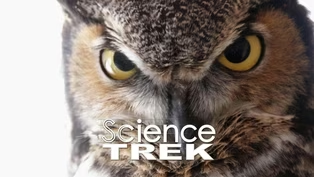
Birds of Prey: Necks, Eyeballs, and Crops
Video has Closed Captions
Clip: Special | 1m 4s | How do owls seem to turn their head 360 degrees? (1m 4s)
Providing Support for PBS.org
Learn Moreabout PBS online sponsorship
- Science and Nature

Explore scientific discoveries on television's most acclaimed science documentary series.

- Science and Nature

Capturing the splendor of the natural world, from the African plains to the Antarctic ice.











Support for PBS provided by:
Science Trek is a local public television program presented by IdahoPTV
Major Funding by the Laura Moore Cunningham Foundation and the Idaho National Laboratory. Additional Funding by the Friends of Idaho Public Television and the Corporation for Public Broadcasting.