
Birds of Prey: How to Fly
Clip: Special | 1m 4sVideo has Closed Captions
How can birds of prey fly so fast?
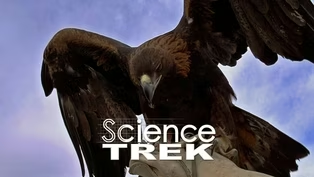
How do birds of prey fly? They have special adaptations that allow them to take off quickly, fly fast and soar for hours. What would it take for us to fly like that?
Problems playing video? | Closed Captioning Feedback
Problems playing video? | Closed Captioning Feedback
Science Trek is a local public television program presented by IdahoPTV
Major Funding by the Laura Moore Cunningham Foundation and the Idaho National Laboratory. Additional Funding by the Friends of Idaho Public Television and the Corporation for Public Broadcasting.
Birds of Prey: How to Fly
Clip: Special | 1m 4sVideo has Closed Captions
How do birds of prey fly? They have special adaptations that allow them to take off quickly, fly fast and soar for hours. What would it take for us to fly like that?
Problems playing video? | Closed Captioning Feedback
How to Watch Science Trek
Science Trek is available to stream on pbs.org and the free PBS App, available on iPhone, Apple TV, Android TV, Android smartphones, Amazon Fire TV, Amazon Fire Tablet, Roku, Samsung Smart TV, and Vizio.

Science Trek
Science Trek is a place where parents, kids, and educators can watch short, educational videos on a variety of science topics. Every Monday Science Trek releases a new video that introduces children to math, science, technology, engineering, and math (STEM) career potentials in a fun, informative way.[MUSIC] JOAN CARTAN-HANSEN, HOST: Birds of prey are the fastest fliers among birds.
But can you guess how they do it?
When a bird of prey takes off, it uses strong legs to push forward and upward.
They have extremely strong chest muscles to flap their wings.
If we humans had strong enough chest muscles to fly, Those muscles would have to be [STRETCHING] 6 ½ feet thick!
Birds of prey's feathers help them maneuver.
The feathers fan out for a fast turn and open up to slow things down.
When a bird lands, their tail feathers open up.
They throw their legs forward and raise their feet.
Their wings act as brakes and their head drops so they can see where they're landing.
The Peregrine falcon is the fastest flier.
It can reach diving speeds of over 200 miles per hour by tucking its wings close to its body.
Peregrine falcons even have special spikes of bones in their nostrils.
It's called a tubercle and it stops air rushing into the bird's windpipe during a high-speed dive.
For more information about birds of prey, check out the Science Trek website.
You'll find it at ScienceTrek.org
Video has Closed Captions
Clip: Special | 1m 4s | Find out how the shape of a bird of prey’s wings will explain why they live where they live. (1m 4s)
Providing Support for PBS.org
Learn Moreabout PBS online sponsorship
- Science and Nature

Explore scientific discoveries on television's most acclaimed science documentary series.

- Science and Nature

Capturing the splendor of the natural world, from the African plains to the Antarctic ice.












Support for PBS provided by:
Science Trek is a local public television program presented by IdahoPTV
Major Funding by the Laura Moore Cunningham Foundation and the Idaho National Laboratory. Additional Funding by the Friends of Idaho Public Television and the Corporation for Public Broadcasting.