Here and Now
Inside Wisconsin Politics: Many Democratic Primaries in 2026
Clip: Season 2400 Episode 2442 | 5m 39sVideo has Closed Captions
Inside Wisconsin Politics on why so many Democrats are running in 2026 primaries.
On Inside Wisconsin Politics, reporters Shawn Johnson, Zac Schultz, Anya van Wagtendonk and Rich Kremer discuss why so many Democrats are running in 2026 primaries for both state and federal offices.
Problems playing video? | Closed Captioning Feedback
Problems playing video? | Closed Captioning Feedback
Here and Now is a local public television program presented by PBS Wisconsin
Here and Now
Inside Wisconsin Politics: Many Democratic Primaries in 2026
Clip: Season 2400 Episode 2442 | 5m 39sVideo has Closed Captions
On Inside Wisconsin Politics, reporters Shawn Johnson, Zac Schultz, Anya van Wagtendonk and Rich Kremer discuss why so many Democrats are running in 2026 primaries for both state and federal offices.
Problems playing video? | Closed Captioning Feedback
How to Watch Here and Now
Here and Now is available to stream on pbs.org and the free PBS App, available on iPhone, Apple TV, Android TV, Android smartphones, Amazon Fire TV, Amazon Fire Tablet, Roku, Samsung Smart TV, LG TV, and Vizio.
Providing Support for PBS.org
Learn Moreabout PBS online sponsorshipmake that true.
>> Reporting from Madison.
I'm Zac Schultz for Here and Now.
>> On this week's Inside Wisconsin Politics, we hear Zac Schultz, along with Wypr political reporter Shawn Johnson, rich Kremer and Anya van Wagtendonk dig into why there are so many Democratic primary candidates in the midterm elections, what party support for a particular candidate does or doesn't say about the campaigns and examples of such races.
Seizing grassroots efforts, won for governor and won for the third Congressional District.
>> In the very recent past, you had Democrats and liberals very wary about jumping into primaries.
What's changed?
Zac?
>> I think the biggest thing that's changed is the Democrats see more opportunity to win some of these over the past 16 years, basically in the Scott Walker era.
On when the maps didn't favor Wisconsin and perhaps the political climate didn't favor candidates statewide, there was a concern that a primary just took up too many resources that were limited, mainly money and time, and the threat that if they went negative against each other, it really hurt their opportunity to win statewide.
Since Democrats have gotten on a roll in 1 a lot of these races for governor, AG, state Supreme Court, and they've got better maps, they see more opportunity.
And so there's more options for people to get in, because the primary doesn't look quite as devastating.
>> Since I'm naming stuff today, this is the don't tell me what to do primary, an important distinction in Democratic primaries.
We've got a couple examples here today.
Let's start with one in the third Congressional District.
Rich, I've heard a lot about this district because it's our most competitive congressional district.
Derrick Van Orden is the Republican incumbent.
I've heard a lot about Rebecca Cooke, the Democratic challenger who has outraised him recently and seems to be getting a lot of attention.
There is a primary there who's running.
>> So the primary is between Cooke, who's an Eau Claire Democrat raised on a dairy farm in the county and, you know, has done some political consulting work, fundraising work for Democrats in years past.
But now she's Bakke.
She's really portraying herself as kind of of the district, you know, born and bred Wisconsin, etc.
Republicans are trying to, you know, focus the attention on her consulting work, etc.
The other Democrat is longtime Eau Claire City Council member, former council president, until just recently, Emily Berge of Eau Claire.
And she she's portraying herself as the grassroots choice in this race.
And national Democrats came in and started sending resources, staff, etc.
back in February to Cooke's campaign.
And Berge said, well, that's pretty dirty.
You know, she essentially said D.C.
shouldn't be deciding who is the Democrat to face Van Orden.
It should be the people of Eau Claire.
And just anecdotally, when I'm walking through the city, I don't see a lot of Cooke signs.
In fact, I don't remember seeing any.
But I see a whole bunch of Berge signs.
So this being one of the more, if not the most populous areas in the third district, maybe that makes a difference.
But in terms of resources, Cooke is way, way, way ahead of Berge in all the fundraising reports that I've seen.
>> Zac, do you get the sense that this is, you know, a competitive primary here?
>> It could be it really depends on how much the primary voters pay attention.
And that's always the issue in some of these primaries is name recognition makes a big deal.
That's why the National Party comes in and puts resources behind Cooke.
It's not necessarily that they like her more.
It's they think she has the better chance to win in the fall and get her moving.
Now.
It's the old mentality we talked about at the beginning of the show of why didn't Democrats do primaries in the past?
It takes resources, it can get ugly, it can get negative.
It could hurt the candidate.
Going into the fall.
I ran into Berge when she was campaigning with Francesca Hong for governor in La Crosse.
They were doing an event at the same bookstore.
And it's not a coincidence that while we were talking to them, they were talking about going and seeing them at the next stop.
And there there is a kind of thematic fit with that campaign of more grassroots, more from the bottom up and running against party types who tell us who our candidates should be.
Parties like to dictate sometimes who the candidate can be so they can focus resources.
Sometimes that does run up against a wall, which is why your title for this Don't Tell Me What to Do, does fit, because there are candidates who are going to say no.
Let the people decide.
People have to pay attention, though.
there are plenty of examples in the recent past, particularly among Republicans, where you come out of a battle tested primary and you are wounded.
And it did not help them very much in the general election.
I think in 2018, Tony Evers came out of a battle tested primary and was a little bit out of money.
So there is a risk to it, but it does also get attention, I guess is the thing that it does for sure.
>> I think another piece of this too, is that it's very easy to kind of present a unified front as a party when you're in the minority, because it doesn't really matter, right?
You don't have power.
And so we might know that kind of behind the scenes, the further left Democrats and the more centrist Democrats don't then they all come forward and kind of vote in alignment.
And so now what we're seeing, because there's a little bit more of a sense that perhaps they could actually win things and gain power.
There's also, I think, a little bit of a fight for what will the Democratic Party in Wisconsin look like, vote like, will they be further left?
Will it be more of a Hong kind of
 New
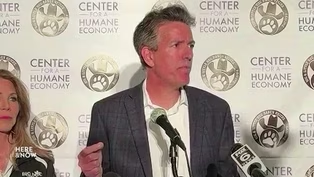
NewAnimal Rights Groups Push to End Biomedical Testing on Dogs
Video has Closed Captions
Clip: S2400 Ep2442 | 1m 21s | Two animal rights groups announce a deal to buy nearly 1,500 beagles from Ridglan Farms. (1m 21s)
 New
NewHere & Now opening for May 1, 2026
Video has Closed Captions
Clip: S2400 Ep2442 | 1m 12s | The introduction to the May 1, 2026 episode of Here & Now. (1m 12s)
 New
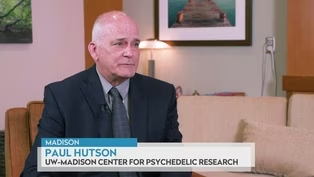
NewPaul Hutson on Potential for Psychedelics in Mental Health
Video has Closed Captions
Clip: S2400 Ep2442 | 7m 9s | Paul Hutson on how psilocybin is used in clinical settings to treat mental health issues. (7m 9s)
 New
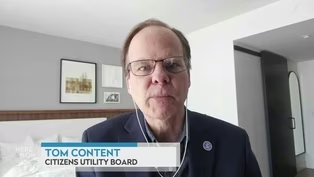
NewTom Content on Data Center Energy Use and Utility Ratepayers
Video has Closed Captions
Clip: S2400 Ep2442 | 5m 39s | Tom Content on an electricity rate plan to shield customers from data center costs. (5m 39s)
 New
NewPolitical Violence and Wisconsin's 2026 Race for Governor
Video has Closed Captions
Clip: S2400 Ep2442 | 4m 57s | Candidates in the 2026 race for governor on political violence and their personal safety. (4m 57s)
Providing Support for PBS.org
Learn Moreabout PBS online sponsorship
- News and Public Affairs

Top journalists deliver compelling original analysis of the hour's headlines.

- News and Public Affairs

Today's top journalists discuss Washington's current political events and public affairs.












Support for PBS provided by:
Here and Now is a local public television program presented by PBS Wisconsin