
Washington Week with The Atlantic full episode, 3/20/26
3/20/2026 | 26m 46sVideo has Closed Captions
Full Washington Week with the Atlantic broadcast from March 20, 2026.
Opposition to President Trump’s continued attacks on Iran is growing. Not only from resentful European allies and Democratic Party leaders, but from parts of his MAGA base. Join moderator Jeffrey Goldberg, Idrees Ali of Reuters, Stephen Hayes of The Dispatch, Vivian Salama of The Atlantic and David Sanger of The New York Times to discuss this and more.
Problems playing video? | Closed Captioning Feedback
Problems playing video? | Closed Captioning Feedback
Major funding for “Washington Week with The Atlantic” is provided by Consumer Cellular, Otsuka, Kaiser Permanente, the Yuen Foundation, and the Corporation for Public Broadcasting.
Washington Week with The Atlantic full episode, 3/20/26
3/20/2026 | 26m 46sVideo has Closed Captions
Opposition to President Trump’s continued attacks on Iran is growing. Not only from resentful European allies and Democratic Party leaders, but from parts of his MAGA base. Join moderator Jeffrey Goldberg, Idrees Ali of Reuters, Stephen Hayes of The Dispatch, Vivian Salama of The Atlantic and David Sanger of The New York Times to discuss this and more.
Problems playing video? | Closed Captioning Feedback
How to Watch Washington Week with The Atlantic
Washington Week with The Atlantic is available to stream on pbs.org and the free PBS App, available on iPhone, Apple TV, Android TV, Android smartphones, Amazon Fire TV, Amazon Fire Tablet, Roku, Samsung Smart TV, and Vizio.
Buy Now
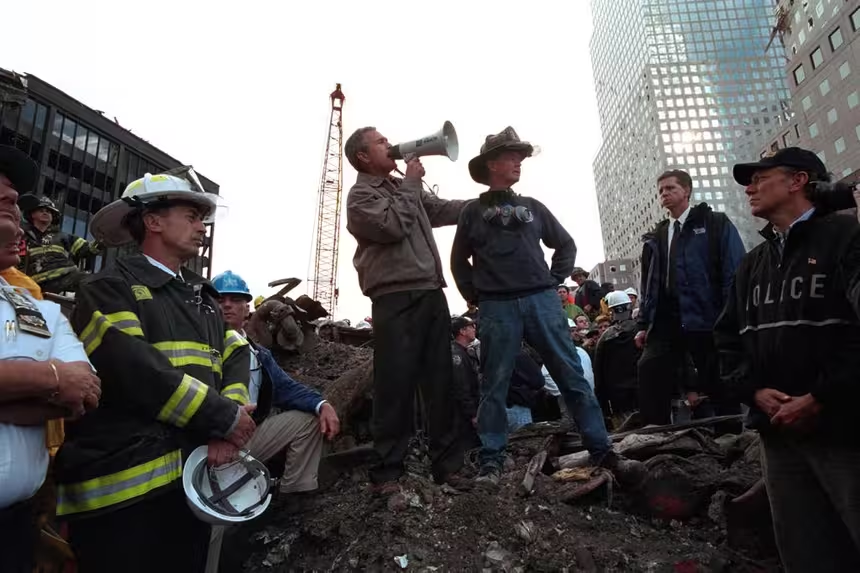
10 big stories Washington Week covered
Washington Week came on the air February 23, 1967. In the 50 years that followed, we covered a lot of history-making events. Read up on 10 of the biggest stories Washington Week covered in its first 50 years.Providing Support for PBS.org
Learn Moreabout PBS online sponsorshipJeffrey Goldberg: Opposition to President Trump's continued attacks on Iran is growing not only from resentful European allies and Democratic Party leaders, but from parts of his MAGA base.
And Trump should expect more opposition when Marines arrive in the Strait of Hormuz.
But will help come from America's Arab allies who are under Iranian attack?
Tonight, what does winning a war with unclear objectives look like, next.
Good evening and welcome to Washington Week.
President Trump is angry at NATO again, insulting the alliance as a, quote, paper tiger, for not supporting his effort to open the Strait of Hormuz, even as he sends more Marines to possibly do that very job.
The war is intensifying in some ways, and Iran appears unready to fold, though it's offensive and defensive capabilities have been quite obviously degraded by continued American and Israeli strikes.
One question hovering all of this, if and when the Arab states of the Gulf under Iranian attack themselves, join in the fight.
Joining me tonight to discuss this and more, Idrees Ali is a national security correspondent and Pentagon correspondent at Reuters, Stephen Hayes is the editor of The Dispatch, Vivian Salama is a staff writer at The Atlantic, David Sanger is a White House and national security correspondent at The New York Times.
Thank you all for being here.
Let me start by reading you showing you something that Donald Trump just posted on Truth Social.
It's his conditions.
He's arguing, it seems today, that most of the conditions for ending the war have been met.
He says that the goals of America include completely degrading Iranian missile capability, launchers and everything else pertaining to them destroying Iran's defense industrial base, eliminating their Navy and Air Force, including anti-aircraft weaponry, never allowing Iran to get even close to nuclear capability, protecting at the highest level our Middle Eastern allies.
So, David, in another presidency, we would say, oh, the president has issued a statement saying that the war is winding down, but in this presidency, what he says today might not be relevant tomorrow.
Is the war winding down?
David Sanger, White House Correspondent, The New York Times: Well, the opening sentence of his statement, Jeff, said, as the war is winding down.
Jeffrey Goldberg: That's why I'm asking.
But don't -- I'm not taking it at face value.
David Sanger: But at the same time, you could argue the war is winding up because he is sending more Marines in.
He is increasing the pace of the attacks.
And we can talk later about what kind of targets they are hitting.
What struck me about the statement was a few things.
First of all, what was missing?
You may remember that when the war began, and the opening hours, he talked about so wiping out the Iranian government that the people could rise up and take over their government.
That was gone here because he recognizes that if he leaves sometime soon, he's going to be left with a rump Islamic Revolutionary Guard Corps -- Jeffrey Goldberg: Right.
David Sanger: -- center to the state.
Jeffrey Goldberg: Right.
David Sanger: He softened his language a little bit about the nuclear program, making sure that they couldn't gain access to it.
Well, that's very different from making sure that all the fuel is out of the country, which was their earlier goal.
And you saw suddenly he was saying to the allies, hey, patrolling the strait is your problem, not our problem, because we don't get oil through the straight.
You do.
Jeffrey Goldberg: Yes.
David Sanger: And the question is, can he actually hand that over?
Jeffrey Goldberg: Yes.
Idrees, how do you read this?
Idrees Ali, National Security Correspondent, Reuters: I think as a Pentagon reporter, we have learned over two now administrations, watch what he's doing, not what he's saying.
And like David mentioned, he is sending 5,000 Marines.
They should be there in a couple of weeks.
The strikes have started to really ramp up.
We've seen about 7,000 targets hits so far.
And so the reality is, if he is looking to wind down, he's not doing a very good job.
All the sort of the tea leaves and the movements indicate that this is going to get a lot tougher and a lot stronger really for Iran.
Jeffrey Goldberg: Are they running out of targets, slowly but surely?
Idrees Ali: Well, it's basic math situation, right?
You hit 7,000 targets.
Iran is known to have about at least 6,000 missiles.
They produce 10,000 drones a month.
And so just basic math-wise, he's probably got a lot of targets he could hit.
And, you know, the one -- Jeffrey Goldberg: Smaller and smaller.
Idrees Ali: Smaller and smaller, but the one important thing, right, we talk about the Strait of Hormuz, mines, they have about 6,000 mines available.
And at some point, you're going to run out of missiles to hit all these small targets.
A small missile, a small drone, can do a lot of damage.
Jeffrey Goldberg: Right.
Steve, you study the ever shifting moods of this White House and this president.
How do you interpret this?
Stephen Hayes, Editor, The Dispatch: Well, I think David's counsel is wise and we're smart to pay attention to what the president is doing more than what he's saying.
He had meetings with allies today at the White House and conversations that military planners had with allies in the region.
There was no indication before the president's tweet tonight that anything had changed, that there was any move to actually draw down.
To David's other point on the war aims, I mean, we've talked about it here before, there are - - he's given many reasons, right, but it was notable that not a word about the Iranian people.
When he gave an interview to The Washington Post three hours after the airstrikes began, he said, I will read it, all I want is freedom for the Iranian people.
And he talked about his legacy in conducting this war being that, and tonight, as he's announcing maybe the winding down of the war, not a mention.
Jeffrey Goldberg: But, Vivian, to be fair to Trump, we've seen other presidents, both parties, make big promises about freedom for other peoples in the greater Middle East and elsewhere, and then kind of reality sets in and, well, maybe we're not going to change the politics and culture of an entire country.
Vivian Salama, Staff Writer, The Atlantic: Absolutely.
Jeffrey Goldberg: So, are we -- is that a -- is the omission a reflection of a kind of sobering reality?
Vivian Salama: I think the omission is part of the fact that he does not know what comes next.
And one of the interesting things about the Post that he put on Truth Social was he can say that we're winding down because he has never quite defined what the endgame looks like, what victory looks like.
And so in this case, you know, he can say it today and then maybe change it tomorrow.
The objectives have also been sort of a moving target.
The president has, for a time, talked about freedom for the Iranian people, but we've also seen that that's not necessarily his M.O.
It's not a priority for him in many of the operations that we've seen in recent months with Venezuela, for example, even though, at one point the administration, did talk about freedom for the Venezuelan people, once the mission was done and Nicolas Maduro was in U.S.
custody.
The focus was economic.
It was, we want the oil.
For President Trump right now, there's so much political blowback over the war, the military has been strained.
He realizes that they've taken on a lot more than they can chew, and at this point he wants to refocus the mission.
Jeffrey Goldberg: But can I ask you about the strain on the military?
That's an interesting point, because I've been thinking a lot about the fact that Iran is a third tier power.
I mean, America has no true peer adversary.
China's a near peer adversary.
But imagine right now if China made a move across the Strait of Taiwan and the U.S.
decided, the president decided that we're going to go defend Taiwan.
Continue on this theme.
Are we learning something about American limitations?
Vivian Salama: Oh, absolutely.
And one of the things that, you know, all of us have been talking to our sources in government, but also some of our foreign sources, and one of the things that we have heard repeatedly in the last few weeks is that the reason that presidents past did not do this, although many of them would've loved to see regime change in Iran, is because the Iranian government always had the ability to weaponize the straits.
And that was some sort of their superpower here, and it was always going to be a losing battle with the U.S.
having to fight this military battle.
Also worry about helping to defend Israel if they were to come under attack.
And then you open this third issue where it's, you know, ensuring safe passage through the straits and making sure that, you know, ships get in and out -- Jeffrey Goldberg: And defending all of the Arabs.
Vivian Salama: And defend -- not to mention defending all the Arabs, which has now opened Pandora's Box for the U.S.
in terms of challenges that they're going to be facing, not to mention the destabilization of the energy markets.
And just layer upon layer, again, they bit more than they could chew and this is something that they're realizing.
Jeffrey Goldberg: Stay on this, because it's a really interesting question.
I mean, we have the greatest military in the history of the planet, the largest and most potent military in the history of the planet.
How much of a strain is this?
Idrees Ali: Yes.
I will point out of Afghanistan, Iraq, the United States came out of those not necessarily winning, I would argue, right?
So, you can be the greatest military force, you can have tactical victories, but until you have a strategy that is defined, it's not going to make a difference.
You know, look, Iran is, like you said, a third tier at best.
The Chinese are ramping up ship production, missile production.
They have capabilities that Iran could only dream of.
And so if you're struggling against an adversary like Iran, you're really going to struggle against China.
And this is with, you know, 50 percent of the Air Force is currently in the Middle East.
That's not currently the case.
Jeffrey Goldberg: David, is the United States actually struggling?
David Sanger: Well, what we're struggling with is achieving our political objectives.
Think about -- Jeffrey Goldberg: Well, we're struggling in defining the political objectives, right?
David Sanger: Well, even as that far, but certainly in achieving the few that the president did lay out the night that the battle began.
So, think about the previous two American attacks.
There was one evening where the Air Force took out three major nuclear sites right within Iran, and then went home.
And so the political objective of setting back the nuclear program and the military objective were one-for-one.
Maduro, same thing, pulled him out of his bed in Caracas.
He ends up in the Brooklyn Federal Detention Center, again, a one-for-one match.
But this time, what we're trying to do is apply so much military pressure that the government itself would collapse and change, and we haven't found in history a single time in modern times that you could bring about regime change just from the air.
And that's why all of a sudden there's all this discussion of, do we need to put troops on the ground to grab Kharg Island, which is where -- Jeffrey Goldberg: Right.
David Sanger: Right, or to get the nuclear material out of Isfahan where it's buried down deep.
And that's why this tends to result in mission creep.
Jeffrey Goldberg: Right.
Stephen Hayes: You know, we should be clear though.
I mean, we have had military success.
I mean, if Iran is a third rate power today, I mean, a nuclear armed Iran, and there's certainly room to debate how close they were, how close they were in June, would have been a significant threat.
Jeffrey Goldberg: I think we know from North Korea that it would have been a lot easier to manage North Korea and protect South Korea if somebody had done this back then.
Stephen Hayes: Right.
So, to me, the way to look at it is short term success, military success in the short-term, which I think we've had a lot.
They're a degraded power.
What -- the power that they had, if they were a third rate, they're a fifth rate now.
I think the real question is what now?
Sort of what comes next in the medium and the long-term?
And, you know, if you look at a regime that's, you know, badly damaged, they've lost a lot of leaders, but still in place, the Basij militias still have power.
They're angrier.
You've got the -- you've shown them the Strait of Hormuz is problematic if they shut it.
We have Arab allies who are, you know, not wanting to get engaged offensively, but don't want to sit back either.
There are plenty of medium and long-term problems that this -- Vivian Salama: Definitely no question about the superiority of the American military.
The question is strategy.
When, you know, the Iranians go in and they start weaponizing the straits, is the United States able to do that?
The president has publicly said this was going to take four to five weeks, but we could go longer.
Jeffrey Goldberg: Yes.
Vivian Salama: Really, what's happening is that we're being drawn in longer because of the circumstances.
Jeffrey Goldberg: But I want to -- I just want to -- I was really struck by something.
Wall Street Journal and other places have reported this, that this is fairly remarkable, you're talking about the limitations of air power to result in regime change.
But -- so you have Israeli drones flying over -- loitering drones, as they say, loitering over Tehran and other cities targeting individual militia, Basij and Rev Guard checkpoints and sites, and the Israelis are getting tips from average Iranians.
Hey, there's a checkpoint over there at the corner of Elm and Maple.
You might want to take it out.
I mean, that suggests to me that the Iranian society is at a tipping point, that they're pretty pleased that Israel and the U.S.
are degrading the power of this hated regime.
Is that a sign that maybe they are closer to tipping?
David Sanger: They may be.
And it could be that - - you know, it takes months for years.
The fact of the matter is Iranian society doesn't have the guns and the Islamic Revolutionary Guard still does.
And the president -- Jeffrey Goldberg: They killed 30,000, we think, people on the street.
David Sanger: In a few days time, right?
And that was actually what instigated all of this.
You know, as you pointed out from what you read.
So, that's the president's first problem.
But his other problem is if you were to rank all of the challenges to the United States, is this the one that you want to be absorbing this much effort into?
Because every administration running up to this for the past 15 years has said it's China that is the number one technologic military economic competitor.
Jeffrey Goldberg: Right.
David Sanger: And are you basically handing it to them by lifting the sanctions on Russia?
Are you undercutting the efforts in Ukraine?
Jeffrey Goldberg: No, it's yet another presidency that is suffering The Godfather dictum.
You know, just when I thought I was out, they pulled me back in.
Although this isn't really the same level of pull as it was after the 9/11 period.
This is more of a -- Vivian Salama: Legacy-seeking.
Jeffrey Goldberg: This is -- it's legacy-seeking.
It's also opportunistic.
It's also lacking strategy in some ways.
I want to talk about part of the strategic problem is that Donald Trump has alienated some allies.
NATO doesn't seem very interested in this.
And I want to play a sound bite from Donald Trump, because, to me, this is probably the most Trump thing that Trump has ever done.
This is in a meeting with the Japanese this week.
Let's just listen to that.
Reporter: Why didn't you tell U.S.
allies in Europe and Asia, like Japan, about the war before attacking Iran?
So, we are very confused about we, Japanese citizens.
Donald Trump, U.S.
President: Well, one thing, you don't want to signal too much, you know?
When we go in, we went in very hard and we didn't tell anybody about it because we wanted surprise.
Who knows better about surprise than Japan, okay?
Why didn't you tell me about Pearl Harbor, okay?
Right?
He's asking me, do you believe in surprise?
I think much more so than us.
And we had a surprise and we did.
Jeffrey Goldberg: You know, I mean, it's like, I don't know what to -- Vivian Salama: I mean, it was a surprise.
Jeffrey Goldberg: That was a surprise.
That was a surprise attack on a meeting.
That sort of thing obviously makes allies not want to come to the Oval Office, much less work in an alliance with.
So, the question is, our allies right now, those who need the Strait of Hormuz open even more than we do directly, what is the mood in your reporting that you're seeing in terms of coming in and helping?
Vivian Salama: There's definitely concern and there's been a lot of reluctance.
You know, NATO allies especially we're very reticent to take part or even offer any support to the United States military, whether it's their bases or, you know, the Gulf countries didn't want the U.S.
in their airspace, even in the lead up to this.
And so, over time, they found that they have little choice, especially with the economic crunch worsening.
They're now -- you know, you have a few nations, the U.K.
leading the charge offering escorts through the straits.
The Gulf countries are now kind of putting one foot forward because they have no other choice or being bombarded.
Jeffrey Goldberg: Yes.
Vivian Salama: And so that's where it stands.
But President Trump is definitely taking notes and listing names as far as countries that did drag their feet because this is what he's complained about all along.
Jeffrey Goldberg: Right.
Idrees Ali: I think the alliances were still fractured going into this, right?
We had the Greenland issue, his closeness to China, to Russia.
So, you're going into this crisis with no goodwill, and we're seeing that lack of goodwill really play a part.
Jeffrey Goldberg: So, one of the questions is, how much of the NATO response -- just not only NATO, but the NATO response, a reaction, a resentment reaction to the way he's treated allies, and how much of it is just we didn't want to invade Iran right now, like we're not -- this is not our game?
David Sanger: Well, part of it was just the absence of consultation, which was the essence of the question.
And, by the way, I lived in Japan for six years.
I'm sure I violated many of their rules, but one of them is no Pearl Harbor jokes.
So, you know -- Jeffrey Goldberg: I would imagine if you're trying to get something done -- David Sanger: Yes, right.
Jeffrey Goldberg: -- with a country that's currently an ally.
David Sanger: But in this particular case, he could have done what George W. Bush did, which was go around the world and try to build a coalition of the willing and make the case before the military action without telegraphing exactly when he was going to attack.
And that worked some for Bush and didn't work with other places.
Jeffrey Goldberg: Yes.
David Sanger: But in this case, no one got consulted.
And so now they're being told, well, you are going to come in to go do -- finish the job for us, and we won't tell you quite what our strategy is for getting out.
Jeffrey Goldberg: And also even if you help us the next day, I might come back to Greenland.
Sorry, I'm laughing because Steve and I covered the Bushes, both Bushes and their efforts to build coalitions in the Middle East.
And as you were talking, Steve is kind of laughing over there, the idea of Donald Trump going around the world and building alliances is -- Stephen Hayes: No, it's inconceivable.
I mean, look, how many times in the past two weeks have we heard him say, we don't need them, we can do it on our own, we don't care, oh, we need them, they'd be smart to do it.
I mean, it's just change.
Look, if it's about trust, goodwill, and common interests, we don't have any trust and there's good reason they don't trust us.
There was reporting this week that the Danes were sending uniform military from allied countries to Greenland in anticipation of a possible U.S.
invasion of Greenland.
They were doing this for a reason because Donald Trump had continuously said that that was on the table or refused to take it off the table.
Goodwill, as Idrees says, he doesn't build goodwill.
He's gone out of his way to insult our allies, particularly in Europe.
Now, we're at the point where there are some common interests and they've got to now look out for their interests, however much they must be frustrated about the comments that he's made and the way that he's sort of given on the back of the -- Jeffrey Goldberg: Right.
Vivian Salama: There was one incident in particular where he recently suggested that allies didn't do enough to support the U.S.
in Afghanistan, and that offended allies around the world.
Jeffrey Goldberg: Oh, I mean, that offended among others the Danes who actually -- Vivian Salama: The Danes especially died in combat.
Jeffrey Goldberg: Steve, stay on this point about dissension and alliance building.
He's having a little bit trouble even in MAGA world building support for this, not just the Joe Kent issue, but there's not a lot of overenthusiasm.
Am I wrong in saying that?
Stephen Hayes: Yes.
I mean, I would make the distinction between sort of a MAGA rank and file who have flipped.
They were skeptical of this war when it started.
Donald Trump said he's for it.
He's talked about why we needed to do it, and they're now for it overwhelmingly.
If you look at sort of MAGA influencer world, the Tucker Carlson and Megyn Kelly set, they have been -- they started, I would say, skeptical and suggested that this would be a betrayal of America first.
Jeffrey Goldberg: Well, and they say that Israel is manipulating him.
Stephen Hayes: They're saying that Israel's manipulating him.
I mean, they're sort of now at the point where they're making every argument they possibly can, but, you know, really who's the fool here that they expected consistency from Donald Trump, that he thought that they thought that he believed these things that he said, that he had a worldview.
This is a personalist foreign policy.
Jeffrey Goldberg: Right.
I want to go to another related issue, which is Cuba, because the lazy Susan is going to come around again, I think, and it's going to be Cuba.
He has talked about taking Cuba.
He talked about it this week.
Vivian, you've been studying this problem for a while.
Do you think that he's actually going to kind of pull a Venezuela with Cuba in the coming months?
Vivian Salama: Yes.
Jeffrey Goldberg: Okay.
Any -- Vivian Salama: While we are all looking over here in the Middle East, the wheels are very much in motion for a Venezuela-style operation in Cuba that would potentially result in regime change.
Now, they are leaving the door open to a negotiated settlement.
They've been very public about that.
President Miguel Diaz-Canel of Cuba came out this week and acknowledged for the first time publicly that he is talking to the administration.
So, they're hoping -- Jeffrey Goldberg: So, the pressure has worked in that sense.
Vivian Salama: It has worked.
But whether or not that means he gets to keep his job, that remains to be said.
Jeffrey Goldberg: I assume, by the way, that successor failure in Iran will very much determine whether there's an appetite for hemispheric adventure.
Idrees Ali: Yes, I agree.
I mean, like he's had successes, right?
Venezuela and Iran was a success.
This might be his first major military failure potentially, right?
And if that fails, how do you do regime change in Cuba?
It's tough.
Jeffrey Goldberg: Right.
David, in our last minute, I want to turn to a subject that actually affects all of us.
A judge just ruled that the Pentagon is violating the First Amendment rights of the press by banning members of the Pentagon Press Corps.
We've all been in the Pentagon Press Corps at one time or another.
Idrees is currently in it.
Tell me about that decision and what it means for the press in the First Amendment.
David Sanger: Well, you know, this was critically important because what was going on here essentially was a test of the question of can you have a free society without a free press?
We had a government that wanted to control the press corps within the Pentagon.
And the judge's ruling is sweeping in its wording.
It's a great reminder of what an editor of mine, Bill Keller, former executive editor of the Times, once said, which I think goes very well for this, which is, there's a reason the First Amendment is first, and this opinion drove that home and told the Pentagon, give them their passes back.
Jeffrey Goldberg: Well, Idrees, it looks like you're going to have to put on a suit and tie again and go back to work.
We're going to have to leave it there.
We'll be back on this subject, of course.
But thanks to our guests for joining me.
And thank you at home for watching us.
For more on Trump's views on Cuba, please visit theatlantic.com.
I'm Jeffrey Goldberg.
Goodnight from Washington.
Trump faces opposition to war from NATO allies, MAGA base
Video has Closed Captions
Trump faces growing opposition to Iran war from NATO allies and his MAGA base (9m 14s)
What does winning a war with unclear objectives look like?
Video has Closed Captions
What does winning a war with unclear objectives look like? (14m 13s)
Providing Support for PBS.org
Learn Moreabout PBS online sponsorship
- News and Public Affairs

Top journalists deliver compelling original analysis of the hour's headlines.

- News and Public Affairs

FRONTLINE is investigative journalism that questions, explains and changes our world.












Support for PBS provided by:
Major funding for “Washington Week with The Atlantic” is provided by Consumer Cellular, Otsuka, Kaiser Permanente, the Yuen Foundation, and the Corporation for Public Broadcasting.