Here and Now
Here & Now for May 1, 2026
Season 2400 Episode 2442 | 26m 47sVideo has Closed Captions
Watch the entire episode of Here & Now for May 1.
Watch the entire episode of Here & Now for May 1.
Problems playing video? | Closed Captioning Feedback
Problems playing video? | Closed Captioning Feedback
Here and Now is a local public television program presented by PBS Wisconsin
Here and Now
Here & Now for May 1, 2026
Season 2400 Episode 2442 | 26m 47sVideo has Closed Captions
Watch the entire episode of Here & Now for May 1.
Problems playing video? | Closed Captioning Feedback
How to Watch Here and Now
Here and Now is available to stream on pbs.org and the free PBS App, available on iPhone, Apple TV, Android TV, Android smartphones, Amazon Fire TV, Amazon Fire Tablet, Roku, Samsung Smart TV, LG TV, and Vizio.
Providing Support for PBS.org
Learn Moreabout PBS online sponsorshipThe following program is a PBS Wisconsin Original production.
>> Personal safety is top of mind for current and would be elected officials after another threat breaches security of the president and state regulators put their foot down, saying Wisconsinites will not subsidize data center energy costs.
[MUSIC] I'm Frederica Freyberg tonight on here.
And now the candidates running for governor say if they fear for their personal safety inside Wisconsin politics redistricting rulings as advocates celebrate new protections from data centers, we check in with the Citizens Utility Board and local research into treating severe mental health with psychedelics gets a boon from an executive order.
It's "Here& Now" for May 1st.
[MUSIC] >> Funding for here and Now is provided by the Focus Fund for Journalism and Friends of PBS Wisconsin.
>> As the political tenor in America continues to deteriorate, threats against politicians have increased, some only online, others very much real and in person.
As part of our continuing series on the most important issues of the election for governor "Here& Now", senior political reporter Zac Schultz asked the leading candidates about this topic.
>> Running for governor is a huge commitment, but in the current political environment, it means candidates and their families also need to consider their own personal safety when deciding to run.
We asked the leading candidates whether that factored into their decision to enter the race, and if they have concerns for their personal safety.
>> We are in a politically charged environment and it's kind of hectic out there.
I had, you know, somebody I had threats before that were, you know, made to me.
It's not a fun thing to experience.
And, you know, it's always back of mind.
But I can tell you like I'm, I'm focused on doing what's right.
I'm going to continue to stay focused on what's doing right.
Violence is absolutely a problem.
It's in it's an issue.
It's something that we cannot ignore.
But I can't let that slow me down either.
>> No more than how dangerous it is to drive here from western Wisconsin on an icy day.
You know, certainly it's disappointing to see the level of.
Noise that is created around politics these days.
And Wisconsinites are looking bring that noise level down.
That's what I'm going to do.
And, you know, despite security concerns, despite things like that, I have the energy to be in this conversation.
That's what Wisconsinites need.
I don't.
>> I love Wisconsin and I believe in Wisconsinites, and I believe that they want us to have an open dialog for politics.
And so I do not have any concerns about my personal safety.
>> It's disappointing that political violence has become such a frequent occurrence, and I'm fortunate to have a campaign team and a community and volunteers across the state that I think are going to remain supportive.
And I, I do not have concerns for my personal safety.
>> I guess I still believe that campaigns are about ideas, and I absolutely I know that there are going to be people who disagree with me and disagree with me on the campaign.
You know, I hope and expect that they're going to do that honorably.
I am more than willing to take pot shots that people have online.
And, you know, and there's a lot of that.
And, and I, you know, I have to have a thick skin around that, but I hope that we're at a place and I hope we can demonstrate in Wisconsin that we do things civilly.
about it a little bit, especially in light of the assassination of Charlie Kirk and, of course, the attempts on President Trump's life in 2024 where he almost lost his life.
So we do think about it more at this point, but I just I try to tune it out because I'm going to do my job and.
Wisconsinites are almost everyone is really good about this stuff, whether I'm knocking on doors, seeing people, whatever.
People are almost always respectful.
And I think it's important for us to be out amongst the public, and I'm not going to stop doing that just because some people have their lives threatened.
huge uptick in political rhetoric and political violence happening all across this country.
And quite frankly, I'm sick and tired of it.
It is unfortunate that we're seeing the level of violence just for being able to deliver on behalf of those that we represent every single day.
And so, you know, whether you're a Republican or Democrat, we need we really need to end the political rhetoric in this violent rhetoric that has been out there and really focus on how do we make lives better for those that we represent?
>> I do, and it's something that I, I take seriously, my staff and my family take it seriously.
And I think it's, it's very unfortunate that we have political leaders at the very top of our system whose use of violent rhetoric and violent actions are making us all less safe.
And as Americans, you know, every one of us lives with the specter of gun violence.
Every time your kid walks out the door to school, every time you go to church or a concert, you have to think, is this going to become a mass shooting event?
We have to do so much more to help all Americans be safe and free from violence.
And there's a lot that states can do to make that true.
>> Reporting from Madison.
I'm Zac Schultz for Here and Now.
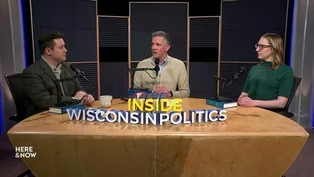
>> On this week's Inside Wisconsin Politics, we hear Zac Schultz, along with Wypr political reporter Shawn Johnson, rich Kremer and Anya van Wagtendonk dig into why there are so many Democratic primary candidates in the midterm elections, what party support for a particular candidate does or doesn't say about the campaigns and examples of such races.
Seizing grassroots efforts, won for governor and won for the third Congressional District.
>> In the very recent past, you had Democrats and liberals very wary about jumping into primaries.
What's changed?
Zac?
>> I think the biggest thing that's changed is the Democrats see more opportunity to win some of these over the past 16 years, basically in the Scott Walker era.
On when the maps didn't favor Wisconsin and perhaps the political climate didn't favor candidates statewide, there was a concern that a primary just took up too many resources that were limited, mainly money and time, and the threat that if they went negative against each other, it really hurt their opportunity to win statewide.
Since Democrats have gotten on a roll in 1 a lot of these races for governor, AG, state Supreme Court, and they've got better maps, they see more opportunity.
And so there's more options for people to get in, because the primary doesn't look quite as devastating.
>> Since I'm naming stuff today, this is the don't tell me what to do primary, an important distinction in Democratic primaries.
We've got a couple examples here today.
Let's start with one in the third Congressional District.
Rich, I've heard a lot about this district because it's our most competitive congressional district.
Derrick Van Orden is the Republican incumbent.
I've heard a lot about Rebecca Cooke, the Democratic challenger who has outraised him recently and seems to be getting a lot of attention.
There is a primary there who's running.
>> So the primary is between Cooke, who's an Eau Claire Democrat raised on a dairy farm in the county and, you know, has done some political consulting work, fundraising work for Democrats in years past.
But now she's Bakke.
She's really portraying herself as kind of of the district, you know, born and bred Wisconsin, etc.
Republicans are trying to, you know, focus the attention on her consulting work, etc.
The other Democrat is longtime Eau Claire City Council member, former council president, until just recently, Emily Berge of Eau Claire.
And she she's portraying herself as the grassroots choice in this race.
And national Democrats came in and started sending resources, staff, etc.
back in February to Cooke's campaign.
And Berge said, well, that's pretty dirty.
You know, she essentially said D.C.
shouldn't be deciding who is the Democrat to face Van Orden.
It should be the people of Eau Claire.
And just anecdotally, when I'm walking through the city, I don't see a lot of Cooke signs.
In fact, I don't remember seeing any.
But I see a whole bunch of Berge signs.
So this being one of the more, if not the most populous areas in the third district, maybe that makes a difference.
But in terms of resources, Cooke is way, way, way ahead of Berge in all the fundraising reports that I've seen.
>> Zac, do you get the sense that this is, you know, a competitive primary here?
>> It could be it really depends on how much the primary voters pay attention.
And that's always the issue in some of these primaries is name recognition makes a big deal.
That's why the National Party comes in and puts resources behind Cooke.
It's not necessarily that they like her more.
It's they think she has the better chance to win in the fall and get her moving.
Now.
It's the old mentality we talked about at the beginning of the show of why didn't Democrats do primaries in the past?
It takes resources, it can get ugly, it can get negative.
It could hurt the candidate.
Going into the fall.
I ran into Berge when she was campaigning with Francesca Hong for governor in La Crosse.
They were doing an event at the same bookstore.
And it's not a coincidence that while we were talking to them, they were talking about going and seeing them at the next stop.
And there there is a kind of thematic fit with that campaign of more grassroots, more from the bottom up and running against party types who tell us who our candidates should be.
Parties like to dictate sometimes who the candidate can be so they can focus resources.
Sometimes that does run up against a wall, which is why your title for this Don't Tell Me What to Do, does fit, because there are candidates who are going to say no.
Let the people decide.
People have to pay attention, though.
there are plenty of examples in the recent past, particularly among Republicans, where you come out of a battle tested primary and you are wounded.
And it did not help them very much in the general election.
I think in 2018, Tony Evers came out of a battle tested primary and was a little bit out of money.
So there is a risk to it, but it does also get attention, I guess is the thing that it does for sure.
>> I think another piece of this too, is that it's very easy to kind of present a unified front as a party when you're in the minority, because it doesn't really matter, right?
You don't have power.
And so we might know that kind of behind the scenes, the further left Democrats and the more centrist Democrats don't then they all come forward and kind of vote in alignment.
And so now what we're seeing, because there's a little bit more of a sense that perhaps they could actually win things and gain power.
There's also, I think, a little bit of a fight for what will the Democratic Party in Wisconsin look like, vote like, will they be further left?
Will it be more of a Hong kind of situation?
Will they be more moderate, more kind of aligned with national Democrats?
And so I think we're seeing that fight kind of play out or tension play out in a lot of these primaries.
projection shows Wisconsin will lose more than $2 billion in sales tax revenue because of an exemption written into the 2325 state budget for data centers, a break designed to promote economic development.
Three years later, the state is swimming in new data centers with consumer concerns about water and energy usage.
But in a win for consumers, the Wisconsin Public Service Commission just ruled that existing electricity customers should not pay a single cent to subsidize the service of data centers.
The ruling is also a major win for the Citizens Utility Board, which fought on behalf of customers.
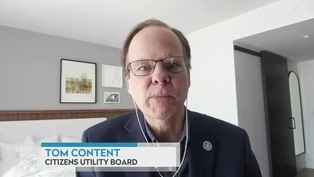
Executive director of Cub Tom Content joins us now with more.
And thanks very much for being here.
>> Oh, great to be with you.
>> So you've said that this case was the most significant one the cub has ever been involved in.
So when the PSC ruled, what was your reaction?
>> I was I was frankly surprised.
I, I've had a good feeling that we were going to get some of what we asked for in terms of significant changes to what the proposal was.
But we got the vast majority of our changes or changes that addressed our concerns.
They really the commissioner really sent a message, even though they can't control every cent, they sent a message that every dollar needs to be accounted for and every.
As they, as one of the commissioners put it, every every cent should be paid for by the tech companies.
>> So how does the proliferation of data centers in Wisconsin engage consumers in a way that other rate cases may not have?
>> It's it's I think I think it's a combination of fear of concerns about rising energy costs, because we've already come into this period with rising energy costs that have risen at rates higher than inflation, paired with the the local community reaction.
And and basically the Wisconsin reaction, as noted in the Marquette polls to data centers.
And, you know, the the Marquette poll that just came out showed a lot more clarity about where Wisconsinites stand about data centers than it showed about who's running for governor.
And they they by a 2 to 1 margin, people said that the cost of data centers outweigh the benefits.
And I think I think layered into that is, is fear of AI and, and what it's what what the the impacts of AI are on the economy and society down the road.
I think that plays into it.
>> Too, because I understand that thousands of people kind of came to Cub and said, yes, we we want the PSC to rule in this way.
>> Thousands of people went to the PSC hearings or PSC hearings or submitted comments online.
And so those could have been people in Milwaukee, people around the state, we energies customers and others.
I mean, frankly, the tech companies and the utility were saying the right things all along that they were going to meet their demand or that they were going to play their own way.
But for us, the devil was always in the details, and we found some loopholes and just areas of concern where we thought the risks that customers were still going to be on the hook were too, too high with what was what was what was the proposal was.
>> So does does the ruling mean that power company customers will not be on the hook at all for the giant energy needs of these data centers?
>> They went as far as they could.
They ran into a couple areas where they couldn't go as far as they wanted, because certain things were out of the state's control.
And what I mean by that is if if people may have seen that at the white House, the tech companies were at the white House pledging to pay their own way and signed a ratepayer protection pledge.
Now, that was more of a, you know, an optics document, a a rhetoric document.
And it was non-binding, but it actually committed the tech companies to pay their way for all the network upgrades, which which to us sounds like the power lines, right.
And the big power lines.
And the fact is, our power line company, American transmission billion of infrastructure to feed these data centers, is actually regulated out in Washington, D.C.
So the state Public Service Commission couldn't change that.
And so as a result, the the the commissioner sent a message that they could only go so far, but they called on HTC and the We Energy's parent company to make changes that would protect customers from, frankly, billions of extra costs tied to these projects.
>> What else stood out for you from the PSC on this case?
>> I think what stood out is, is that the the.
The fact that the data centers will be on the hook for 100% of the new power plants.
There was one scenario where other customers, small businesses, homeowners, renters would be on and other businesses would be on the hook for up to 25% of the cost of new power plants.
And that's not a small number.
We energies has already gotten approval for over almost 2 billion in projects and has another 6 billion in the queue.
So a quarter of that, a quarter of that would have been a couple billion dollars on the hook that customers would have been responsible for.
So.
So that was a big the biggest change and one that we really appreciated.
>> All right.
Well, we appreciate you joining us today on this Tom Content.
Thanks so much.
>> Thank you.
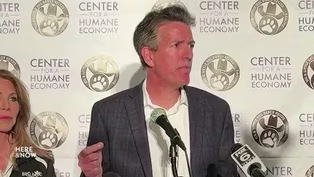
>> Two animal rights groups announced a deal with a breeding and biomedical testing facility to purchase 1500 of their dogs.
This comes following a failed but high profile attempt by activists to break into the facility and liberate the animals.
Earlier this month, Ridglan Farms was investigated for animal abuse but was not charged on the condition they agreed to give up their breeding license.
Next week on our program, we'll speak with the special prosecutor in that case.
But the animal rights group says more needs to be done to end what it says is unnecessary.
Biomedical testing on animals.
>> This system of testing is broken.
It's been broken for a very long time.
The data show that in more than 90% of cases where a new drug passes muster, in ten years of animal tests, when it then goes to human clinical trials, it fails more than 90% of the time.
You know, the NBA playoffs are happening now.
If you had a free throw shooter who hit one of every ten free throws, that person, that player would be on the bench.
Why is a 92% failure rate considered some sort of success?
>> An executive order from President Donald Trump calls for fast tracking research and access to psychedelic medicines for treatment of mental health disorders, with $50 million in funding going to state governments for the research into the treatments, the FDA pinpointed three companies, including Madison based Usona Institute, for its new drug Application for psilocybin in major depressive disorder.
Usona says the designation is reserved for therapies addressing critical national health priorities and unmet medical needs.
The work of UW-Madison researchers will be part of Usona application.
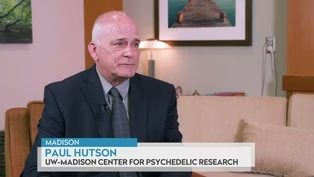
The center for Psychedelic Research has been looking at the promise of psilocybin and other psychedelics with human research subjects at its dosing lab on campus, we met with Professor Paul Hutson there to learn more.
>> Psilocybin kind of works by itself.
We're here primarily to protect the subject, reassure them if they get anxious.
>> So we are sitting in a room where patients or research subjects are administered psilocybin.
What happens.
>> When somebody is coming in for a psychedelic dosing session with psilocybin, for example?
They come after about 3 or 4 hours of preparatory counseling and intention setting with the therapists that are going to be sitting with them.
They'll come in, they'll lie down on the sofa.
After taking the capsule of psilocybin, and then the two therapists, which would be sitting in the chairs that we're in facing the person on the sofa, would watch and attend them, reassure them if that was something that needed to happen with a hand on the shoulder, perhaps.
And then after about six hours, they would be evaluated to make sure that they were safe to go home.
They'd go home in the care of someone that they trusted that could make sure that they got home safely.
And then we bring them back the next day, typically, and have a 1 or 2 hour debriefing and ideally bringing them back 2 or 3 more times.
We think that that debriefing session, that ability to work with those people with whom they've got a therapeutic alliance is critically important to really maximize the effects of the psychedelic treatments.
And one of the reasons why we don't expect that recreational use of psychedelics is going to be anywhere near as therapeutically effective as the more controlled, somewhat more complex work with the therapists.
>> What do they experience?
>> That's hard to describe, and it's going to be different for every individual.
And frankly, it's probably different for every medication that we're using.
There's a lot of hallucinogen effects like seeing sounds and abnormal visions of patterns in the carpet, patterns in the wall.
But they also describe a noetic, all knowing sense of knowledge that they've experienced something very profound.
On the other hand, they typically describe it as being ineffable, very difficult to explain.
Sometimes they feel like they've come into the presence of a deity of God.
Others feel a very, very alone, like they're in a canoe in the middle of the ocean on a very dark night and feel very isolated.
But then on the other hand, they that same person might then be visited by friends and deceased relatives.
At least that's what some would describe.
And so it's really hard to pin down a particular experience for any individual.
>> What is the promise of treatment with psychedelics for things like depression or PTSD?
>> It's amazing, quite honestly, what the effects of one dose of psilocybin seem to have.
We see some really remarkable results in individuals with depression, sometimes treatment resistant depression, and that can occur within 24 hours.
And it seems to be durable in many individuals.
Not all.
Not everybody responds like that.
Just like any medication.
We also see in our own work with methamphetamine, but also other institutions looking at alcohol, tobacco, cocaine, some really remarkable rapid responses in terms of decreased uses of these drugs of abuse.
I think that one of the things that really surprised me when I first got into this was that the psilocybin and LSD treatments are not addictive, that I was part of the this is your brain on drugs generation.
And so that was a surprise.
But it's really important to to make it clear that we do screen the individuals that we bring into our studies.
And I think it's going to be important to screen the individuals that come to us after drug approval.
>> What was your reaction when you learned of this executive order?
That kind of gives the FDA fast track.
>> So the executive order does several things, but the thing that I think is going to have the greatest impact on our work and the psychedelic industry as a whole, is that it is going to accelerate the rate at which the FDA can evaluate drugs like this.
And in particular, three companies got these national program vouchers.
That is going to accelerate even more.
The speed at which the FDA is reviewing their applications for approval.
The concern that I have, quite honestly, is that the FDA will approve this sooner than we were expecting, and we don't really have the capacity in terms of rooms, but especially the therapists that are going to attend these individuals to accommodate the demand that's going to occur when that happens.
>> And this would be happening presumably at research centers across the country.
>> Once the drug is approved by the FDA, it does not have to be at a research center.
I think that they are right now the ones that are best positioned to accommodate that.
But frankly, it's going to be both an academic and a private for for profit enterprise as well.
People will need to go to some of these clinics that will charge them out of pocket for the experience.
The the personnel demands to have the two therapists sitting in the room for eight hours is going to be one of the most critical things that we have to deal with.
How are we going to, in a system where mental health professionals are hard going to expand that capacity to meet the demand from the psychedelic industry?
>> And Steil, this is really exciting news.
I imagine for someone like yourself.
>> It is really exciting.
Yes, we have participated in the development of psilocybin from about 12 years ago, and some of our work is actually going into the the new drug application that Usona Institute is going to be working on.
So we're really excited that we can be part of that.
But helping other companies, but also looking at the mechanism of why this happens.
We've got several studies that were just asking the foundational question, why does it work and how does it work?
And how can we perhaps make it better?
>> For more on this and other issues facing Wisconsin, visit our website at PBS wisconsin.org and then click on the news tab.
That's our program for tonight.
I'm Frederica Freyberg.
Have a good weekend.
>> Funding for "Here& Now" is provided by the Focus is provided by the Focus Fund for Journalism and friends of PBS Wisconsin.
 New
NewAnimal Rights Groups Push to End Biomedical Testing on Dogs
Video has Closed Captions
Clip: S2400 Ep2442 | 1m 21s | Two animal rights groups announce a deal to buy nearly 1,500 beagles from Ridglan Farms. (1m 21s)
 New
NewHere & Now opening for May 1, 2026
Video has Closed Captions
Clip: S2400 Ep2442 | 1m 12s | The introduction to the May 1, 2026 episode of Here & Now. (1m 12s)
 New
NewInside Wisconsin Politics: Many Democratic Primaries in 2026
Video has Closed Captions
Clip: S2400 Ep2442 | 5m 39s | Inside Wisconsin Politics on why so many Democrats are running in 2026 primaries. (5m 39s)
 New
NewPaul Hutson on Potential for Psychedelics in Mental Health
Video has Closed Captions
Clip: S2400 Ep2442 | 7m 9s | Paul Hutson on how psilocybin is used in clinical settings to treat mental health issues. (7m 9s)
 New
NewTom Content on Data Center Energy Use and Utility Ratepayers
Video has Closed Captions
Clip: S2400 Ep2442 | 5m 39s | Tom Content on an electricity rate plan to shield customers from data center costs. (5m 39s)
 New
NewPolitical Violence and Wisconsin's 2026 Race for Governor
Video has Closed Captions
Clip: S2400 Ep2442 | 4m 57s | Candidates in the 2026 race for governor on political violence and their personal safety. (4m 57s)
Providing Support for PBS.org
Learn Moreabout PBS online sponsorship
- News and Public Affairs

Top journalists deliver compelling original analysis of the hour's headlines.

- News and Public Affairs

Today's top journalists discuss Washington's current political events and public affairs.












Support for PBS provided by:
Here and Now is a local public television program presented by PBS Wisconsin