
Market to Market - April 24, 2026
Season 51 Episode 5136 | 26m 45sVideo has Closed Captions
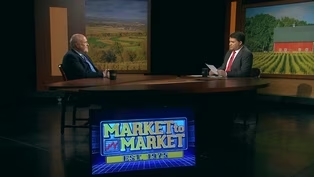
Commodity market analysis with Dan Hueber.
On this edition of Market to Market ... The head of U.S. trade is called to Capitol Hill to answer questions about tariffs along with producer and consumer prices. One egg producer is expanding his supply chain, one small farm at a time. And, commodity market analysis with Dan Hueber.
Problems playing video? | Closed Captioning Feedback
Problems playing video? | Closed Captioning Feedback
Market to Market is a local public television program presented by Iowa PBS
Market to Market - April 24, 2026
Season 51 Episode 5136 | 26m 45sVideo has Closed Captions
On this edition of Market to Market ... The head of U.S. trade is called to Capitol Hill to answer questions about tariffs along with producer and consumer prices. One egg producer is expanding his supply chain, one small farm at a time. And, commodity market analysis with Dan Hueber.
Problems playing video? | Closed Captioning Feedback
Where to Watch Market to Market
Market to Market is available to stream on pbs.org and the PBS app.
Providing Support for PBS.org
Learn Moreabout PBS online sponsorshipComing up on Market to Market.
The head of U.S.
Trade is called to Capitol Hill to answer questions about tariffs, along with producer and consumer prices.
One egg producer is expanding his supply chain.
One small farm at a time and commodity market analysis with Dan Hueber next.
>> [MUSIC] >> I wouldn't be here without my customers.
>> Yeah, I'd like to thank the customers.
They're they're very dear to our hearts.
>> It's about the people that you're working with and the relationships that you have.
>> Thank you, thank you, thank you.
>> Thank you from the bottom of my heart >> [MUSIC] >> Tomorrow.
>> For over 100 years, we've worked to help our customers be ready for tomorrow >> [MUSIC] >> Trust in tomorrow.
Information is available from a Grinnell Mutual agent today.
>> This is the Friday, April 24th edition of Market to Market, the weekly Journal of Rural America.
>> Hello, I'm Paul Yeager.
Higher prices at the gas pump may have one good side.
It likely led to the biggest gain for retail sales in three years.
The monthly reading added 1.7% in March.
The surge in sales was driven by the 15.5% escalation of prices at the pump brought on by the war with Iran.
An increase in inflation is also part of that equation, and is on the minds of many in Congress.
A hearing this week called by the committee charged with tax policy, trade agreements and tariffs focused on those three items.
With the president's point person on those topics.
David Miller reports on the House Ways and Means Committee and the testimony from the U.S.
Trade Representative.
>> A situation that may be favorable.
U.S.
Trade Ambassador.
Jamieson Greer spent.
>> Several hours fielding questions from members of the House Ways and Means Committee.
Non-Tariff trade barriers.
Much of the discussion focused on tariffs.
With the president going to China.
What do you think?
What's the agenda?
How can we protect U.S.
Markets?
>> I think everyone knows that no one has been more clear eyed on the challenge posed by the by China.
The economic challenge and national security challenge than President Trump.
This is why he put tariffs on China in the first term, including on Chinese automobiles.
It's why he pioneered rules on information and communication technology to make sure that vehicles that have that there was a regime.
So the vehicles that have technology from China in them can't can't be used in the United States.
>> American families are struggling under the administration's trade agenda.
Gas prices have gone through the roof.
Fertilizer has gone through the roof, and all the food that we eat and consume has gotten more expensive and about to get even worse.
Mr.
Ambassador, can you commit today to let the section 122 tariffs expire without adding new tariffs?
>> The president, his trade policy has not changed.
He's not going to go back to the old situation where we had no tariffs.
And we just let foreign goods made by foreign workers come in without any fee, to the detriment of domestic workers.
I know that Democrat attorneys general and Democrats here, they want to have that system.
They want to have a system where there's no tariffs, and all this stuff just comes in.
But we're not going to have that.
So the president will continue to have tariffs using appropriate legal tools.
>> Farm economy is in a very, very bad place, including with the rise in fertilizer prices.
What more is the administration considering when it comes to addressing concerns faced by our farmers and ranchers?
And is the administration still considering considering utilizing tariff revenue to provide targeted support for American agriculture?
>> So we we are very aware of the input cost issue and fertilizer prices skyrocketed under the Biden administration.
And but they still haven't come down enough, in our view.
And I think we probably all share that view.
Under the Biden administration, there was an initiative started to allocate money to smaller fertilizer producers that was never acted upon.
The USDA is now actively going through applicants to that program.
>> Prices are lower, really, because as a working mom who grocery shops every week, I have seen prices go up and up and up, and you can try to spin it any way you want.
But I think consumers, you know, unanimously.
Promise to bring down costs.
They were forced to pay more than $165 billion for Trump's illegal tariffs that the court struck down.
Do you think the American people who have been paying higher prices because of these illegal tariffs deserve to be paid back too.
>> I reject the premise of this.
When you look at things like eggs, it's gone down by 45%.
Smartphones down by four.
>> The question that I asked, the question that I ask is, do you think the American people who have been paying higher prices because of the illegal tariffs should be paid back?
Also?
>> Sanchez.
>> Simple.
Yes or no?
>> They haven't been paying higher prices because of these tariffs.
>> These >> I.
>> Wait.
>> For market.
>> To market.
>> I'm David Miller.
>> I have limited time.. >> For nearly six decades, the consumer movement to know where your food comes from has been expanding.
This can create a gap between what consumers want and the availability of products.
On the other side of the equation are producers looking to satisfy those specific needs, with a chance at adding to their bottom lines.
One poultry farmer took the consumer search for pasture raised eggs and turned the idea into $1 billion business.
Here's Peter Tubbs with our cover story.
>> A flock of Kharg Island brown hens search for bugs on a farm in southern Missouri.
Access to pasture and forest qualifies these hens as pasture raised, but managing poultry was a new venture for this farm.
>> Vital farms projections.
They give us projections on new growers and.
It was just something that we thought would diversify us even more because it's not.
If.
It's when there's going to be ups and downs.
>> Pace also runs a cow calf operation with his parents experience with livestock made adding 20,000 hens a natural fit in 2019.
>> When we did first one, people looked at us like we were crazy.
It's kind of not normal for Howell County, Missouri.
Usually you you do what grandpa did and you do what dad did, and that's how it goes.
But, you know, kind of a step of faith.
>> Vital farms has been selling specialty eggs since 2007.
The firm has been steadily increasing the number of farms it partners with as demand for its eggs has grown, much of the demand comes from the company's uncommon model.
>> We have a very unique proposition within the the egg community.
We are an opportunity for farmers to own and operate independently.
We're a buy sell model where farmers have an opportunity to manage and operate independently.
We sell them our chicks.
They own those chicks, and then we buy the eggs from them.
We are there to coach, mentor, help from the moment they receive those chicks to the moment those chicks go out of production.
Along that journey, for the 80 weeks in which they are operating that farm, we're there by their side to make sure that they can be as successful as possible.
>> The primary attraction for consumers is that vital farms eggs are pasture raised, the hens are cage free and can leave the barn during most of the day, returning to their roots in the barn at dusk.
Each barn is surrounded by a series of paddocks, which are rotated every 21 days.
>> We believe very rigorously in a high definition and high standard of animal welfare.
That is the differentiator for the Vital Farms brand and what differentiates us from any other egg brand in the marketplace.
To be quite honest with you, you might believe that eggs are eggs.
Some people believe that eggs are a commodity.
We beg to differ.
>> From a grower standpoint.
The primary difference from commodity eggs is the lack of a tournament model where farmers compete against other farmers and the lowest performing farms find their contracts canceled.
>> We'll provide the support regardless of how that farm is producing.
Now, we were going to do anything that we can to support that farm, to ensure that their farm is as productive as possible >> Producers working with Vital Farms commit 25 acres of paddock for the hens, and each farm is limited to two barns, or 4000 layers.
Vital farms sources its eggs from what it describes as the pasture belt, where grass can be grown year round.
A region from eastern Oklahoma and Kansas through Tennessee, Kentucky and southern Ohio, vital Farms has seen dramatic growth over the last five years.
>> When I came here, I think we were $100 million brand.
We, by the end of this year, will be $1 billion brand in five years time.
You don't have an opportunity to do that very often.
>> The ten fold growth in sales required expanding from 200 farms in eight states to over 600 farms in nine states.
Processing and packaging of vital farms.
Eggs occurs at Egg Central Station in Springfield, Missouri.
After an expansion that included a third processing line 5 million eggs passed through the facility daily, nearly double the throughput from 2024.
>> So as we brought on new farms, partners with more farm families, we also at the same time intentionally grew the capacity here at the plant.
But we knew we had to gain an exponential number, right?
We needed to get 30, 40, 50%.
So we took down a portion of the plant that was coolers.
And we dedicated that to a third line.
Let us double our overall capacity through the course of the year.
>> A second processing plant is under construction in Indiana, which will allow eggs to be sourced from the eastern part of the grazing belt.
In an industry that strives to reduce its supplier count, Vital farms views, dispersed sources of eggs as an advantage.
>> We partnered with 600 family farms and critically, where those family farms are located is also important because if there's a terrible storm in one state, you got farmers all over the other states.
Bird flu, breakout, whatever it might be.
It's not a bunch of chickens in one building.
They're spread out across all these states, across all these farms, out on pasture.
>> Each carton of eggs can be traced back to the farm where the eggs were laid.
Vital farms is one of the largest certified B corps in the food industry, which requires meeting social and environmental performance standards.
The commitment to small farms and pasture raised hens is part of Vital's marketing strategy.
As a growing swath of Americans put more focus on how their food is sourced, specialty eggs become more attractive and justify their premium prices.
Specialty eggs can be a profit center for retailers, becoming more valuable than commodity eggs, which are often sold at a discount to drive foot traffic.
The rapid growth in demand for vital Farms eggs has created a new revenue stream for hundreds of small family farms.
Pace has broken ground on his second barn.
>> Whenever we first started with vital, they ran on happy hens and at first I thought, yeah, okay, but truthfully, seeing them out here, scratching in the pasture, you know, just living where they naturally want to live is, is pretty pretty satisfying.
>> For Market to Market, I'm Peter Tubbs >> Next, the Market to Market report >> Dry conditions.
Influence on the trade yielded to forecasts of rain late week for the week ending April 24th.
The nearby wheat contract added $0.18 and the July corn contract gained $0.06.
Beans continued their double sided trade in the soy complex.
The July soybean contract fell a nickel, while July meal was off $8.10 on the week.
July cotton shrank by $0.48 per hundredweight.
May class three milk futures added $0.57.
The livestock market was lower as June cattle cut 227.
August feeders declined 415 and the June lean hog contract, weakened by $1.78.
In the currency markets, the U.S.
Dollar index put on 62 ticks.
June crude oil added 15%, or $12.32 per barrel.
Comex gold fell 146 $0.50 per ounce, and the Goldman Sachs Commodity Index was up by more than three points to settle at 73112.
Here now to lend us his insight on these and other trends as regular market analyst Dan Huber.
Hello, sir.
>> Hello.
How are you?
>> Wonderful.
>> Very good.
>> Let's talk wheat.
Okay.
Because it's a bright spot.
A couple of reasons.
What are the two for you that are the biggest?
>> Well, of course, reduced acreage once again.
But then the dry weather and the southern plains that has stimulated so.
And truly, it's the only market out there that has a weather story at this point in time.
You know how long that continues on?
We shall see.
But it you know, it has been the bright spot in the in the grain soy sector here really since the first of the year.
But, you know, most specifically over the last couple of weeks here, so.
>> Well, there's some who think it hasn't responded enough, including those of you who submitted questions.
So let's start, if we could, with Roger in Nebraska, who's in that area where this is a everyday question.
When will the Board of Trade finally pay attention to the severe drought in the southeast and middle sections of this country?
>> You know, and again, one, I would say we have paid attention.
Granted, it's not a wild type of situation, but, you know, keep keep it in perspective as well that, you know, we're not looking at any kind of a tightness necessarily in wheat.
Yes, yes.
The hard red maybe could be a little a little tighter situation.
But when you look at wheat as a whole, globally, domestically, you know, we're not looking at a cringe situation.
So now do I is there a possibility we could see Kansas City wheat maybe pushed to the $7 mark?
You know, I think that's a real threat.
If we don't see the weather change here in the near term.
But but here again to wheat is available.
In fact, I read today that we were importing some wheat at this point because worldwide wheat is significantly cheaper than domestic wheat.
So you know, that's going to be that tempering effect that keeps caps on markets.
>> Is this a time for action?
>> Oh I think so.
You know I think you know again we'll I know we'll cover more than wheat here.
But absolutely I think you you know, all supply markets, all supply rallies, I should say, tend to be short lived by nature because they are driven by weather, by a one off type of situation.
And if you don't reward them, you know, you tend to regret it later.
So yes, I think you anything from here on up, you want to be rewarding.
>> So all right, so that's wheat.
How about let's talk old crop corn.
Is there a reward to be had here.
>> Well we've had a little bit of a bounce the last couple of weeks.
Pretty anemic.
You know corn demand has not really been bad.
We continue to post pretty respectable export sales.
But you know that said if we don't do it now, when are we going to do it.
So it's yes old crop corn.
It's going to be difficult to think we're going to get carried away if we can make it up, we've in the last week retraced about half of what we lost since the the March peak.
We may able to maybe could extend it just a bit more than here, but I think it's going to be a challenge to, to really take that much higher without getting concerns about what's going on with the new crop.
>> Well, we're getting ready to we're putting in that new crop.
Correct.
We're a little distracted with that.
We're watching the weather.
Sure.
So what is it going to take as a headline on that old crop to maybe pry some more of this loose?
>> Well, I think we'd probably have to see the rains really continue and push planning further back to where we start talking about losing acreage.
You know, there is again, the the whole war in Iran situation has, as we painfully know, in the farm sector, really boosted not only fuel prices, but of course, fertilizer prices.
You know, I think the market's trying to factor that in right now.
Do we need to be building in a risk premium if people use less fertilizer, are we going to be able to maintain trendline yields.
Those kind of questions.
Nobody can provide the actual answer to that.
Of course, at this point in time.
But that said, I think that is the one the one point you could look at and say, well, there's potential for that.
So.
>> Well, it's interesting you say it on the old crop side, because there's a thought that it's going, Iran's going to be more of an influence on the new crop side.
>> Sure.
Well, but I mean, I once that does happen, people will tend to grab what they can.
I see, you know, so yeah, not that it's going to be the driving force taking old crop higher.
But if you really get concerns about the new crop that we may not have as many bushels available there, people will tend to do a little hoarding, you know, maybe buy some stocks right now to make sure I have inventory for later on.
>> Are we to the point yet where we have seen acres change because of fertilizer, fertilizer situations?
>> I, you know, certainly a possibility, you know, and again, I have not really heard much discussion of that just yet.
And of course, you know, again, unless somebody is forced to change, you know, a lot of seed is booked probably, you know, hopefully a lot of fertilizer has been booked.
But if not, I think it's going to be pushing it right to the end before you see a change.
And again, I think it's probably going to be more weather related than price related at this point, particularly when you consider that the soybean prices are not exactly stellar or at least the action, the soybean market is not exactly stellar at this point.
>> Well, the action's been, I think what you called earlier this week very much.
It's been range.
We've we've been stuck at three five day average not breaking out.
Except yesterday we did break out lower.
>> Right.
Not not.
>> All that.
>> Say not all the way out of the range.
But I think it's kind of taking you to the edge saying that, boy, if we don't come back with a better bull story, or if the story really starts, we turn into rally that yes, it looks like we're going to see more bean acres on the ground.
Boy, it would be tough to hold soybeans, at least at current levels.
Demand wise, boy, it's not existent here at this point.
You know, China bought their their initial rounds after the first of the year.
You know, certainly our March shipments to China were better than a year ago, but they still weren't good, you know, so it's we're quite a ways behind the eight ball and that's why we market.
>> Oh.
And then that South America situation too.
They keep growing.
Lots of grain.
Is that are they as big as I mean they're almost done with this first crop.
>> Soybean harvest is almost complete.
>> So that means any premium or challenge is likely out of the market to.
>> Oh, certainly.
Yeah.
I mean, and again, it will only be a transportation issue at this point.
But but at this point in time, South America is going to own that nearby soybean market.
>> So is there anything that a producer should do right now, given there's a lot in the market, there's not a lot of activity or excitement in soybeans.
>> Sure.
The, you know, hopefully, hopefully they've already taken taken advantage of the the rallies we had post January 1st.
But you know, right now, I'd say if you're sitting on extra beans, you either ought to have a put on there or be ready to pull the trigger.
If this market starts tipping lower from here.
So it's and you know, here again, two upside.
Even if we could talk about new crop a little bit, you know, we've nearly pushed $12 beans at the highs and back in back in March.
We're a bit below there at this point in time.
But even if there was an explosion to the upside, you know, $0.50 more, you know, we're not talking about dollars and dollars of rally ahead of us here.
>> Right.
I was going to ask you about this $12 number.
What's the is it a mental or a technical.
>> A combination of both.
But I mean, certainly psychologically $12 is interesting.
You know, when I look at the November's the November situation, you know, a year ago in January, we gapped below $12.50.
And we've never revisited.
>> That.
>> There was a weather scare or something or, you know, we had some other bullish factor that came into the soybean market.
1250 is probably going to cap it off.
So, I mean, you're really not talking about, you know, even a 10% rally from where we stand.
You know, that's more like a 5% rally from where we stand.
So it's, it's not like there's great upside potential here.
>> That sounds like focus on the planting, not worry about the marketing of beans right now.
>> Well, you know, here again, then, you know, don't just leave it out there.
I think you have to be sold ahead on this.
You know, if you think you need to have some weather protection, do it with calls.
You know, it's it's why leave too much, too much risk out there to the downside.
>> Cotton started well finished last week.
Well continued early this week.
And now the last couple of days we've sold off.
What's going on there.
>> You know again it's been been a huge rally since the beginning of the year.
You know granted dryness in the south of course, just like impacting wheat has been impacting cotton market.
The exception there though is we have we are looking at probably a little higher acreage this year.
So I think at this point in time, you've probably squeezed all you can out of the weather concerned rally.
So it's we'd have to find something new to try to think prices can move higher than this.
>> Is this is there a squeeze going on in the live cattle market right now?
>> Oh, I don't know if he'd say squeeze per se.
I mean, we really did take a pretty good wash out here over the last few weeks trying to build that back up here.
Once again.
I think this will be the true test.
I mean, if we can if we can't sustain this rally beyond next week, then I think it's you know, we're probably looking at some pretty major tops on the cattle market.
But I mean, we've been saying that for a year and a half.
You know.
>> This is as close as we've had to signals.
Right.
>> Exactly, exactly.
>> So then what does that mean?
>> Well I think one we're probably have deferred enough demand or should should say discouraged enough demand that is making impact.
We know we're trying to do I shouldn't say we that the U.S.
Is importing beef to, you know, uninhibited here at this point in time.
So, you know, there's been a lot of effort to try to put a cap on food prices.
And I think beef is the number one culprit that everybody's after at this point in time.
>> Have you been impressed or disappointed in boxed beef here lately?
>> Well, I good question, good question.
Neither you know, I mean, I think it's just normal trade.
Yeah.
>> Yeah.
Which means we're likely going to no matter how much you import, we're going to probably be stuck at a certain price level, right.
>> For the time being.
Right.
>> Feeder wise, after last week's cattle on feed report, there was this thought that, oh, here we go.
We're opening up the door.
>> Sure.
>> We dropped, but we stabilized at the end of the week.
Why is it about retention?
Is it about exhaustion?
>> I would say it's also about, you know, a anemic corn trade, you know, to where it you know, not not as much fear about what what prices are going to be on the input side of it.
So but, but I think, you know, that that with the cattle market itself kind of teetering on the edge of a major question, do we have a high end place here?
You know, I think that could evaporate the the premiums in the feeder market pretty rapidly.
>> So hog market, though, maybe, maybe.
>> Maybe about.
>> Him, the bottom is.
>> In, right?
I mean, we've had a very solid push to the downside.
Bounced away from those lows earlier this week.
And then we finished a bit weaker today but didn't go to new lows.
So I think there's a better than 5050 odds that we have a low in here.
And we'll see more of a seasonal climb up into the summer months again.
>> Is there a certain driver on this.
>> Oh you know other than normal summer demand, I wouldn't say a major a major driver at this point in time.
>> Because there's no trade story.
I mean, every once in a while we hear about this summit that could happen between the U.S.
And China in May.
Soybeans is the headline in that Pork doesn't seem to be a part of that discussion.
>> No, no.
And again, when you look at the pork exports have been reasonable this year.
But, you know, China themselves, you know, granted, they can tell us a lot of things if they follow through or not.
But I mean, China has really has a ten year goal to really trim back on meat imports.
And, you know, again, they've.
>> Well trimmed back on a lot of imports.
>> Imports period.
Correct?
Correct.
I mean, there again, you know, we all have a stated goal of expanding production year after year.
You know, you're limited by geography certainly over there.
But, you know, the technological advances we continue to see in production, particularly in crop production, you know, could be their ace in the hole there too.
So.
>> Well, it's good to have you here as our ace in the hole.
We always.
>> Appreciate it.
Ace inhibitor always a pleasure to be here.
>> Certainly.
Thank you much.
>> You bet.
Thanks, Dan Hueber.
>> Everyone on our market analysis segment, that's what you've been watching here on this program.
In a moment, Dan and I will continue our discussion in that online only segment, we call it Market Plus.
So here's how you find it.
You search Market Plus with Dan Hueber wherever that you get your podcasts.
You can also go to our website of Markettomarket.org to listen.
Thank you to those of you who've joined our Facebook club by liking or following our page, come see our posts of photos, links, and questions to keep you in the loop with this program.
Join us at facebook.com slash Market to Market.
Show next week.
What a thinner winter snowpack means for producers out west.
Thank you so much for watching.
Have a great week.
>> [MUSIC] [MUSIC] >> Market to market is a production of Iowa PBS, which is solely responsible for its content >> [MUSIC] >> I wouldn't be.
>> Here without my customers.
>> Yeah, I'd like to thank the customers.
They're they're very dear to our hearts.
>> It's about the people that you're working with and the relationships that you have.
>> Thank you, thank you, thank you, thank you from the bottom of my heart.
>> [MUSIC] >> Tomorrow for over 100 years, we've worked to help our customers be ready for tomorrow.
>> [MUSIC] >> Trust in tomorrow.
Information is available from a Grinnell Mutual agent today.
>> This week on Market to Market.
What a thinner winter snowpack means for producers out west.
Ethanol demand is growing and commodity Market Analysis with Arlan Suderman Markettomarket.org.
>> [MUSIC]
Video has Closed Captions
Clip: S51 Ep5136 | 11m 9s | Dan Hueber talks higher markets, trust in numbers, the Iran War and weather. (11m 9s)
Providing Support for PBS.org
Learn Moreabout PBS online sponsorship New Episode
- News and Public Affairs

Top journalists deliver compelling original analysis of the hour's headlines.
 New Episode
- News and Public Affairs

Today's top journalists discuss Washington's current political events and public affairs.


 New Episode
 New Episode
 New Episode
 New Episode
 New Episode
 New Episode
 New Episode
Support for PBS provided by:
Market to Market is a local public television program presented by Iowa PBS